NATA 2027: Exam Dates, Registration, Eligibility, Syllabus, Pattern & Exam Centres — Complete Guide
Everything B.Arch aspirants need to know about NATA 2027 the exam is still months from its official notification, so here's how to plan your prep timeline.
NATA is the furthest out of all the major design/architecture entrances covered in this series — the Council of Architecture (CoA) typically releases its notification only in March, just before the first test window opens. Here's what's known, what's projected, and how to use the runway you have.

NATA Exam 2027 Details
| Particular | Details |
|---|---|
| Exam Name | National Aptitude Test in Architecture (NATA) 2027 |
| Conducting Body | Council of Architecture (CoA) |
| Purpose | Admission to 5-year B.Arch programmes across India |
| Application Mode | Online only |
| Official Website | nata.in |
| Notification Release | Expected March 2027 |
| Exam Format | Multi-session — conducted on designated Fridays and Saturdays across a multi-month window |
| Total Marks | 200 |
| Exam Duration | 3 hours |
| Attempts | Up to 3 per year (candidates can retake to improve scores) |
Because NATA runs on a rolling, multi-session model rather than a single exam day, "exam date" for NATA really means a window of dates you can choose from during registration.
NATA 2027: Expected Important Dates
| Event | Expected Date (Tentative) |
|---|---|
| Notification & brochure release | March 2027 |
| Registration opens | March 2027 |
| Registration closes (per session) | 3rd week of March 2027 onward — deadlines recur weekly per test window |
| Phase 1 exam window | April–June 2027 (Fridays & Saturdays) |
| Phase 2 exam window | August 2027 |
| Result declaration | Within 7 days of each exam date |
Because NATA uses rolling registration, the "last date to apply" effectively resets for every test date — you register for the specific Friday or Saturday session you want, subject to seat availability.
Eligibility Criteria for NATA 2027
| Criterion | Details |
|---|---|
| Educational qualification | Passed or appearing in Class 12 (10+2) with Physics and Mathematics as compulsory subjects, plus one of: Chemistry, Biology, Technical Vocational Subject, Computer Science, IT, Informatics Practices, Engineering Graphics, or Business Studies |
| Alternative route | 10+3 Diploma (recognised) with Mathematics as a compulsory subject |
| Minimum aggregate marks | 50% (45% for SC/ST/OBC/PwD candidates, based on recent cycles) |
| Age limit | No upper age limit prescribed |
| Nationality | Indian, OCI, PIO, and Foreign Nationals eligible |
| Score validity | One academic year (2027–28 admission cycle) |
Since NATA scores feed directly into B.Arch admissions at colleges regulated by CoA, always cross-check your target college's specific eligibility rules alongside CoA's general criteria — some institutions apply additional cutoffs.
MAD SCHOOL NATA Results

See What Our Students Have To Say About Their Success with MAD School
Application Fee (Expected, Based on Recent Cycles)
| Category | Fee (Per Test Attempt) |
|---|---|
| General / OBC | ₹1,750 |
| SC / ST / EWS / PwD | ₹1,250 |
| Transgender | ₹1,000 |
| Outside India | ₹15,000 |
Since NATA allows multiple attempts, fees are charged per test — appearing twice roughly doubles your total outlay, so it's worth preparing thoroughly for your first attempt rather than treating retakes casually.
NATA 2027 Exam Centres
CoA publishes a list of probable test cities in the official brochure, and candidates select their preferred city during registration — the final allotment depends on availability. Based on recent cycles, NATA centres span nearly every state, including:
- North: New Delhi, Dehradun, Kanpur, Lucknow, Noida, Greater Noida, Ghaziabad, Jhansi
- West: Ahmedabad, Anand, Rajkot, Surat, Vadodara, Mumbai, Pune, Nagpur, Nashik, Kolhapur, Aurangabad
- South: Bengaluru, Mangalore, Hubballi, Mysuru, Hyderabad, Secunderabad, Chennai, Coimbatore, Trichy, Ernakulam/Kochi, Thiruvananthapuram, Kozhikode
- East: Bhubaneswar, Cuttack, Kolkata (Durgapur, Howrah), Guwahati, Ranchi
- Central: Bhopal, Gwalior, Indore, Raipur
- Union Territories / International: Puducherry, Port Blair, and an international centre in Dubai
The exact 2027 city list is confirmed only in the official brochure — treat the above as a strong indicator of coverage rather than a final list.
NATA 2027 Exam Pattern
NATA is conducted in a hybrid format — Part A on paper, Part B on computer — for a total of 200 marks across 3 hours.
| Part | Mode | Duration | Content | Marks |
|---|---|---|---|---|
| Part A — Drawing & Composition | Offline, pen & paper | 90 minutes | 3 questions testing composition & colour, sketching, and 3D visualisation | 80 |
| Part B — Aptitude Test | Computer-based (adaptive) | 90 minutes | 50 questions — 42 MCQs + 8 NCQs (numerical/no-choice) covering mathematics, logical/visual reasoning, and architectural awareness | 120 |
Qualifying criteria: A minimum total of 70 marks out of 200, with at least 20 marks in Part A and 30 marks in Part B (based on recent cycles — always confirm against the current year's brochure, as CoA has adjusted qualifying rules in some past cycles).
Negative marking: None in either part.
NATA 2027 Syllabus
The NATA 2027 syllabus is designed to assess a candidate’s drawing ability, visualisation skills, spatial understanding, logical reasoning, design sensitivity and basic numerical ability. The examination tests more than just artistic skills. It looks at how well a student can observe their surroundings, understand forms and spaces, analyse situations and communicate ideas visually.
The syllabus can be broadly divided into two parts:
- Part A – Drawing and Composition
- Part B – Aptitude Test
NATA 2027 Syllabus
| Part | Section | What It Tests |
|---|---|---|
| Part A | Composition and Colour | Creativity, visual composition and colour sense |
| Part A | Sketching and Composition – Black and White | Observation, proportion, perspective, scale and visual representation |
| Part A | 3D Composition | Spatial thinking, form, balance and three-dimensional visualisation |
| Part B | Visual Reasoning | 2D/3D visualisation and spatial relationships |
| Part B | Logical Derivation | Logical interpretation, analysis and deduction |
| Part B | G.K., Architecture and Design | Awareness of architecture, design, buildings, materials and developments |
| Part B | Language Interpretation | English comprehension, grammar and interpretation |
| Part B | Design Sensitivity and Thinking | Observation, critical thinking, problem identification and design awareness |
| Part B | Numerical Ability | Basic mathematics and geometry applied to spatial and creative problems |
NATA 2027 Part A Syllabus: Drawing and Composition
Part A focuses on a candidate’s ability to observe, imagine and communicate ideas through drawing and visual composition. It is not simply a test of how realistically a student can draw. The section also evaluates how effectively a candidate can arrange elements, understand space, maintain proportion and create a visually convincing response.
1. Composition and Colour
This section tests the ability to create a balanced and visually appealing composition using given shapes, forms or a particular situation.
Candidates may need to rearrange different shapes or elements to create a suitable composition and use colour appropriately.
Important areas to practise include:
- Visual composition
- Arrangement of shapes
- Balance and proportion
- Colour combinations
- Colour harmony
- Visual hierarchy
- Creativity in composition
- Positive and negative space
- Creating compositions based on a given situation
The focus is on understanding how different elements work together visually, rather than simply colouring neatly.
2. Sketching and Composition – Black and White
This section tests the ability to visualise and represent a situation through drawing. The situation may involve buildings, architectural elements, people, products or the surrounding environment.
Important areas include:
- Proportion and scale
- Perspective
- Spatial understanding
- Line quality
- Shapes and forms
- Textures
- Light and shadow
- Depth
- Placement of people and objects
- Relationship between built and natural elements
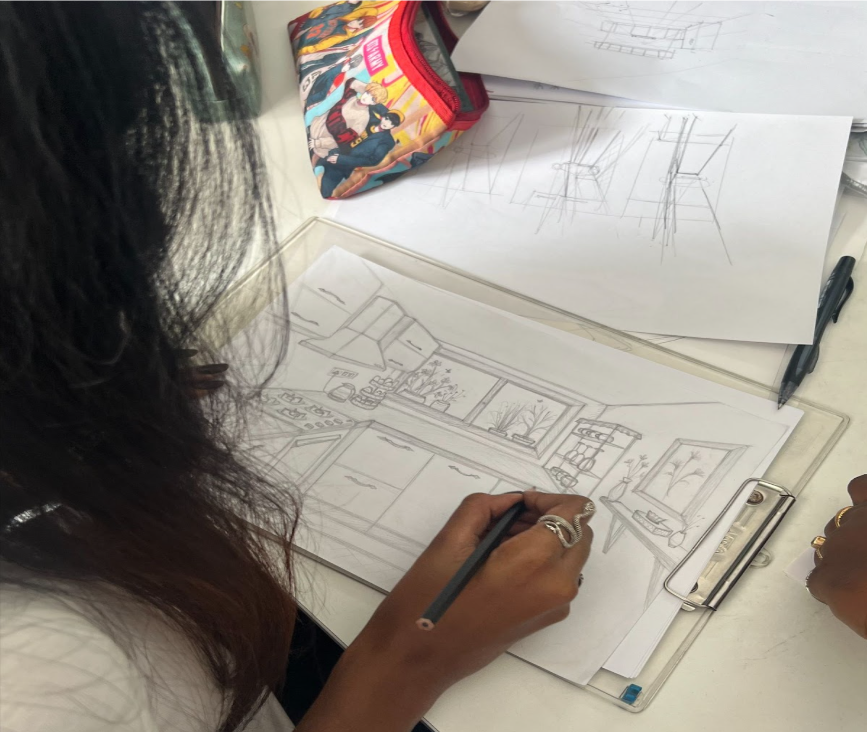
For example, a candidate may be asked to imagine and sketch a scene involving a building, people and objects while maintaining an appropriate sense of scale and perspective.
Regular practice of freehand sketching, perspective drawing and observation-based drawing can help build the skills required for this section.
3. 3D Composition
The 3D Composition section tests the ability to think beyond a flat drawing and understand form, space and three-dimensional relationships.
Candidates may be required to create an interesting three-dimensional composition for a given situation using the provided kit.
Important skills include:
- Understanding 3D forms
- Spatial visualisation
- Balance and stability
- Arrangement of forms
- Transformation of basic shapes
- Understanding depth
- Creating visually interesting compositions
- Representing light and shadow
- Thinking creatively within given constraints
This section requires students to think about how different forms occupy and interact with space.
Important Topics to Prepare for NATA Part A
Students preparing for the drawing and composition section should develop a combination of drawing, observation and spatial visualisation skills.
Some important areas to practise are:
- One-point perspective
- Two-point perspective
- Freehand sketching
- Architectural sketching
- Object drawing
- Human figures and proportions
- Composition using basic shapes
- Colour theory
- Colour combinations
- Light and shadow
- Textures
- Scale and proportion
- Spatial depth
- Memory drawing
- Visual storytelling
- 2D to 3D visualisation
- 3D form creation
- Observation-based drawing
A good preparation routine should include regular timed drawing practice rather than relying only on occasional sketching.
NATA 2027 Part B Syllabus: Aptitude
Part B focuses on visual, logical and analytical thinking. It covers visual reasoning, logical derivation, architecture and design awareness, language interpretation, design sensitivity and numerical ability.
1. Visual Reasoning
Visual Reasoning tests how well a candidate can understand and manipulate visual information.
Questions may involve 2D and 3D forms, compositions, patterns and spatial relationships.
Important areas include:
- 2D and 3D visualisation
- Spatial relationships
- Shape transformation
- Mental rotation
- Visual reconstruction
- Pattern recognition
- Understanding forms and compositions
- Interpreting visual information
- Perspective and spatial concepts
- Mirror images
- Paper folding and unfolding
- Different views of objects
The objective is to develop the ability to mentally understand what an object or composition would look like from another position or after a transformation.
2. Logical Derivation
Logical Derivation tests the ability to analyse a given situation, identify relevant information and arrive at a logical conclusion.
Questions may require candidates to:
- Identify patterns
- Analyse relationships
- Interpret situations
- Recognise hidden information
- Draw conclusions
- Identify cause-and-effect relationships
- Eliminate incorrect possibilities
- Apply logical reasoning to visual or contextual problems
- Understand information presented through images or situations
The emphasis is on understanding and reasoning, rather than simply memorising facts or formulas.
3. General Knowledge, Architecture and Design
This section requires students to develop awareness of architecture, design, buildings, materials, construction and developments in the field.
Important areas include:
- Famous architects and designers
- Important buildings and landmarks
- Indian architecture
- Global architecture
- Architectural styles
- Historical development of architecture
- Design movements
- Building materials
- Construction technology
- Innovation in architecture and materials
- Contemporary architecture and design
- Sustainable architecture
- Current developments in architecture and design
Students should develop both static architectural knowledge and awareness of recent developments in architecture, design and the built environment.
4. Language Interpretation
Language Interpretation evaluates the ability to understand and logically interpret English words, sentences and written information.
Preparation should cover:
- Reading comprehension
- Vocabulary
- Word meanings
- Synonyms and antonyms
- Grammar
- Sentence interpretation
- Meaning of words and phrases
- Understanding relationships between sentences
- Logical interpretation of written information
The objective is not advanced literary knowledge. It is primarily about being able to read, understand and interpret information accurately.
5. Design Sensitivity and Thinking
Design Sensitivity is an important part of NATA preparation because it focuses on how well a candidate can observe everyday surroundings and think about people, products, spaces and the environment from a design perspective.
Important areas include:
- Observation
- Critical thinking
- Understanding user behaviour
- People and their surroundings
- Products and everyday objects
- Public spaces
- Built environments
- Identifying problems
- Defining a problem
- Analysing situations
- Understanding visual communication
- Semantics and metaphors
- Interpreting subtle forms of communication
- Understanding how design affects everyday experiences
This section encourages students to look at everyday situations from a designer’s perspective.
Instead of simply asking “What is this?”, a design-oriented approach also asks:
- Why has it been designed this way?
- Who is going to use it?
- How does the design affect the user?
- What problem does it solve?
- Could it be made more useful or accessible?
- What could be improved?
Developing this way of thinking can be useful not only for NATA but also for architecture school.
6. Numerical Ability
Numerical Ability covers basic mathematics and its application to spatial and creative thinking. Geometry is particularly important because architecture involves an understanding of shapes, dimensions, measurements and spatial relationships.
Students should revise areas such as:
- Basic arithmetic
- Ratio and proportion
- Percentages
- Profit and loss
- Simple and compound interest
- Time, speed and distance
- Geometry
- Mensuration
- Shapes and dimensions
- Area and volume
- Coordinate geometry
- Basic numerical reasoning
- Mathematical interpretation of situations
The objective is not simply to solve textbook mathematics problems but to become comfortable applying mathematical thinking to forms, spaces and practical situations.
Also Read: Top 3 Architectural Colleges In Hyderabad
Other Important Areas to Cover for NATA 2027
Along with the main syllabus categories, students preparing for NATA should also develop familiarity with the following areas.
Elements and Principles of Design
Students should understand the basic elements and principles that influence visual composition:
- Line
- Shape
- Form
- Colour
- Texture
- Space
- Balance
- Contrast
- Rhythm
- Proportion
- Hierarchy
- Unity
Visual Perception
Understanding how we see and interpret:
- Shapes
- Patterns
- Forms
- Depth
- Perspective
- Spatial relationships
- Visual hierarchy
- Positive and negative space
Colour Theory
Important concepts include:
- Primary colours
- Secondary colours
- Tertiary colours
- Warm and cool colours
- Complementary colours
- Colour harmony
- Colour contrast
- Colour perception
Architectural Awareness
Students should build basic awareness of:
- Building elements
- Architectural vocabulary
- Building materials
- Construction methods
- Famous structures
- Architectural styles
- Indian architecture
- International architecture
- Sustainable architecture
- Contemporary design
- Important architects and designers
Spatial Visualisation
Practise:
- Mental rotation
- 2D-to-3D transformation
- 3D-to-2D representation
- Cube and block visualisation
- Perspective
- Spatial relationships
- Form manipulation
- Different views of objects
How to Prepare for the NATA 2027 Syllabus
NATA preparation works best when drawing practice and aptitude preparation are done together. Spending all your preparation time on sketching while ignoring reasoning, mathematics or architecture awareness can leave important areas uncovered.
A balanced preparation routine should include:
For Part A
- Daily sketching
- Perspective practice
- Composition exercises
- Colour studies
- 3D form exercises
- Light and shadow practice
- Observation drawing
- Memory drawing
- Timed drawing exercises
For Part B
- Visual reasoning questions
- Logical reasoning
- Geometry and basic mathematics
- Architecture and design awareness
- English comprehension
- Design-based observation exercises
- Current architecture and design developments
- Timed aptitude practice
The most important thing is to practise thinking visually, not just memorising topics. NATA tests a combination of creativity, observation, spatial understanding and analytical ability, so preparation should reflect that combination.
NATA 2027 Syllabus Checklist
Before the exam, make sure you are comfortable with:
- Composition and colour
- Freehand sketching
- Perspective
- Scale and proportion
- Light, shade and shadow
- Textures
- 3D composition
- Spatial visualisation
- Visual reasoning
- Logical derivation
- Basic mathematics and geometry
- Architecture and design awareness
- English language interpretation
- Design sensitivity
- Observation and critical thinking
- Current architecture and design developments
In short, NATA 2027 is not only a drawing examination. It tests whether you can observe, visualise, reason and communicate ideas — skills that form an important foundation for studying architecture.
How to Prepare for NATA 2027
- Build drawing speed under real time pressure. With only 90 minutes for 3 drawing questions, practice completing full compositions — not just sketches — within tight windows.
- Don't neglect Part B mathematics. Unlike NID/UCEED, NATA has a defined PCM (Physics-Chemistry-Mathematics) component in its aptitude section — NCERT Class 11–12 level math and basic physics/chemistry concepts show up directly.
- Practice 3D visualisation specifically. Mentally rotating and reconstructing forms is a distinct, trainable skill that NATA tests heavily in both parts.
- Use the multi-attempt structure strategically. If your Phase 1 score isn't where you want it, NATA's rolling format lets you retake in Phase 2 (August) with lessons learned — but budget for the added fee and revision time.
- Stay current on architectural awareness. Notable buildings, materials, and construction basics feature in Part B's GK-adjacent questions.
Structured NATA Prep at Mad School
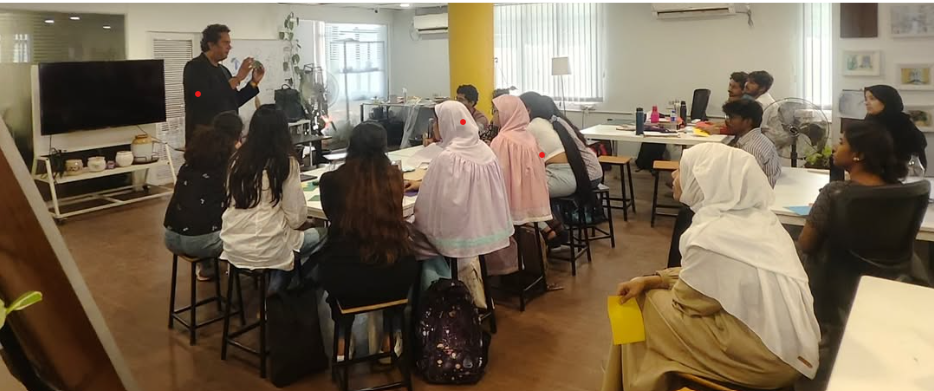
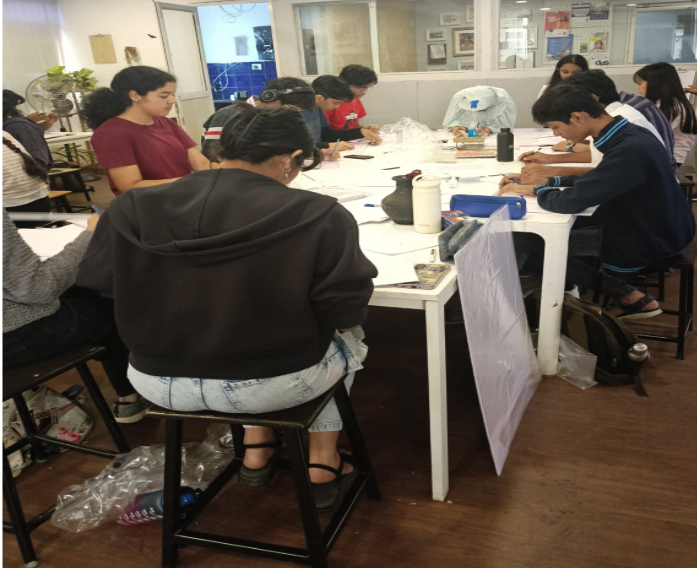
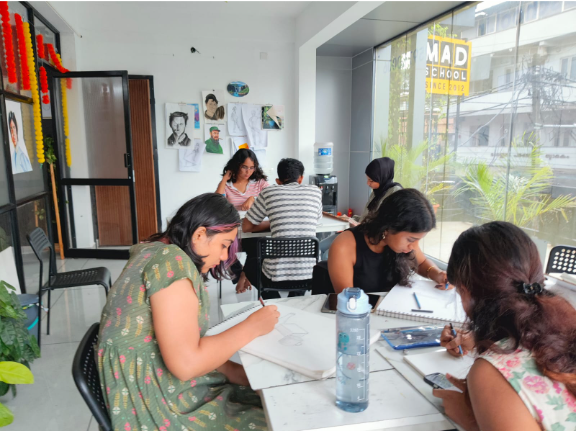
NATA's split between drawing speed, spatial reasoning, and PCM-based aptitude means a single generic "design entrance" prep plan often falls short. Mad School's NATA coaching in hyderabad, chennai and kerala builds on the same studio-and-mentorship model used in our broader NID coaching preparation programmes, with dedicated drawing-speed drills, adaptive-test practice for Part B, and a structured math/physics/chemistry refresher for candidates whose PCM is a few years rusty.
FAQ's
Not yet. CoA typically releases it around March 2027, shortly before the first test window opens.
Up to 3 attempts per year across the exam's multiple test windows, with your best score typically considered for admission.
No — neither Part A nor Part B has negative marking.
Mathematics is compulsory, along with Physics and one additional subject from a defined list (which can include Chemistry, but also alternatives like Computer Science or Business Studies).
No upper age limit is prescribed.
Is There a Minimum Qualifying Score for NATA 2027?
No minimum qualifying marks or fixed cut-off have been prescribed for NATA 2027.
The valid qualifying score will be reflected in the candidate's final NATA scorecard. For Phase 1, the scorecard will indicate the candidate's best Raw Score along with the corresponding non-zero Percentile Score. For Phase 2, the Raw Score will be considered.
How Are Multiple NATA Attempts Considered?
Candidates can take multiple attempts according to the phase-wise rules:
- Phase 1: Candidates can appear for a maximum of two attempts. The best score will be considered for the final evaluation.
- Phase 2: Candidates are allowed only one attempt.
Can a NATA 2026 Score Be Used for Admission in 2027?
Yes. Candidates who have a valid NATA 2026 score and have not taken admission can use that score for admission to the 2027–28 academic session.
However, there is an important condition: if a candidate with a valid NATA 2026 score appears for NATA 2027, their NATA 2026 score will become invalid. In that case, only their NATA 2027 performance will be considered.
How Long Is the NATA 2027 Score Valid?
The NATA 2027 score is valid only for the 2027–28 academic session. Candidates cannot use the score for subsequent academic sessions.
Does IIT accept NATA score?
No, the Indian Institutes of Technology (IITs) do not accept NATA scores for admission to their Bachelor of Architecture (B.Arch) programs.
Explore More Design & Architecture Entrance Exam Guides
If you're also considering design programmes alongside architecture, check out our other 2027 guides:
- NID DAT 2027: Exam Dates, Registration, Eligibility & Exam Centres — for B.Des and M.Des at the National Institute of Design.
- UCEED 2027: Exam Dates, Registration, Eligibility & Exam Centres — for B.Des at the IITs and IIITDM Jabalpur.
- CEED 2027: Exam Dates, Registration, Eligibility & Exam Centres — for M.Des/PhD design programmes.
- NIFT 2027: Exam Dates, Registration, Eligibility & Exam Centres — for B.Des, B.FTech, M.Des, MFM, and M.FTech at NIFT.
NATA's rolling, multi-session format (April–August 2027) gives it the longest runway of any exam in this series — many B.Arch aspirants use the months after their NID/UCEED/NIFT attempts to sharpen drawing speed and PCM fundamentals before their first NATA session.