CEED 2027: Exam Dates, Registration, Eligibility, Syllabus, Pattern & Exam Centres — Complete Guide
Everything M.Des and PhD (Design) aspirants need to know about CEED 2027, conducted by IIT Bombay on January 17, 2027.
If you're a graduate targeting an M.Des or PhD design seat at IIT Bombay, IIT Delhi, IIT Guwahati, IIT Hyderabad, IIT Gandhinagar, IISc Bangalore, IIITDM Jabalpur, or another participating institute, CEED is your entry point. Here's everything confirmed so far, plus what's still pending.

CEED Exam 2027 Details
| Particular | Details |
|---|---|
| Full Form | Common Entrance Examination for Design |
| Conducted By | IIT Bombay |
| Purpose | Admission to M.Des and PhD (Design) programmes |
| Exam Date | January 17, 2027 (confirmed) |
| Session Timing | 9:00 AM – 12:00 Noon |
| Notification & Registration | Expected October 1, 2026 |
| Participating Institutes | IIT Bombay, IIT Delhi, IIT Guwahati, IIT Hyderabad, IIT Gandhinagar, IISc Bangalore, IIITDM Jabalpur, and other participating institutes |
| Exam Mode | Part A: Computer-based; Part B: Pen-and-paper |
CEED is held on the same day and in the same session as UCEED, though the two exams serve entirely different candidate pools — UCEED for Class 12 aspirants, CEED for graduates.
CEED 2027: Important Dates
| Event | Date (Tentative unless noted) |
|---|---|
| CEED Exam date | January 17, 2027 |
| Notification & registration portal opens | October 1, 2026 |
| Last date to apply (without late fee) | October 31, 2026 |
| Last date to apply (with late fee) | November 7, 2026 |
| Admit card release | First week of January 2027 |
| Result declaration | First week of March 2027 |
| Institute-wise application for M.Des/PhD | February–April 2027 |
The exam date itself is locked and official. Registration and result dates remain tentative until the full information brochure drops on October 1.
CEED 2027 Exam Centres
CEED is conducted across roughly 27 cities in India, drawing from a city network that closely overlaps with UCEED's, since both exams run out of the same IIT Bombay infrastructure on the same day. Expect centres in major hubs such as Ahmedabad, Bengaluru, Bhopal, Bhubaneswar, Chandigarh/Mohali, Chennai, Delhi, Guwahati, Hyderabad, Jaipur, Kolkata, Lucknow, Mumbai, Pune, and other regional centres. The exact list is confirmed in the October notification, and candidates typically select three cities in order of preference — no centre change is entertained after registration closes.
Eligibility Criteria for CEED 2027
| Criterion | Details |
|---|---|
| Qualifying exam | Bachelor's degree, diploma, or PG degree of minimum 3 years after 10+2, or in the final year of such a programme (completing by July 2027) |
| Alternative qualifications | 5-year Professional Diploma from CEPT, B.F.A. (Bachelor of Fine Arts), or GD Arts Diploma (10+5 level) |
| Minimum marks to appear | None — no minimum percentage required to sit the exam itself |
| Age limit | None |
| Number of attempts | Unlimited — but a fresh application and fee are needed for every attempt |
| Score validity | 1 year from result declaration |
Note: while there's no minimum percentage to appear for CEED, individual institutes set their own admission cutoffs (commonly around 60% or CPI 6.0 for General/OBC, with a 5% relaxation for SC/ST) — always check your target institute's specific requirement.
CEED 2027 Application Fee (Expected)
| Category | Fee |
|---|---|
| General / OBC | ₹4,000 |
| Women / SC / ST / PwD | ₹2,000 |
| Late fee (all categories) | ₹500 additional |
Fees are non-refundable and must be paid online during registration. A fresh fee applies to every attempt — CEED doesn't allow carrying forward a previous registration.
How to Apply: CEED 2027 Registration Steps
- Visit ceed.iitb.ac.in once the notification is released and register with a valid email ID and mobile number.
- Fill in personal, academic, and category details.
- Select your exam cities in order of preference.
- Upload documents — photograph, signature, degree/marksheet proof, and category/PwD certificates as applicable.
- Pay the application fee online.
- Download the confirmation page for your records.
After the CEED result, remember that clearing CEED alone doesn't guarantee an IIT seat — you'll need to apply separately to each institute's M.Des/PhD admission process (typically February–April), each with its own small application fee.
CEED 2027 Exam Pattern
CEED is a 250-mark exam spread over 3 hours, split into two compulsory parts. You must clear the Part A cutoff for your Part B answer sheet to even be evaluated.
| Part | Mode | Duration | Questions | Marks |
|---|---|---|---|---|
| Part A | Computer-based (objective) | 1 hour | 44 (NAT: 8, MSQ: 10, MCQ: 26) | 150 |
| Part B | Pen-and-paper (drawing) | 2 hours | 5 (20 marks each) | 100 |
Negative marking: MCQs carry 0.5, MSQs use partial/negative marking, and NAT questions have no negative marking — all in Part A only. Part B has no negative marking.
Final score weightage: 25% from Part A + 75% from Part B — so Part B is where CEED is really won or lost, even though Part A determines whether it gets evaluated at all.
A score above 50–60 is generally considered a good qualifying score, though actual cutoffs vary by institute and programme.
CEED 2027 Exam Syllabus - PART A
| Subject | CEED 2027 Part A Syllabus Topics / Details |
|---|---|
| Visualization and Spatial Reasoning | Ability to visualise and transform 2D shapes and 3D objects and understand their spatial relationships. |
| Practical and Scientific Knowledge | Knowledge of scientific principles and everyday objects. |
| Observation and Design Sensitivity | Ability to detect concealed properties in daily life and think critically about them; includes attention to detail, classification, analysis, inference and prediction. |
| Environment and Society | General awareness of environmental, social and cultural connections with design. |
| Analytical and Logical Reasoning | Ability to analyse qualitative and quantitative information. |
| Language | Proficiency in reading and comprehending Standard English. |
| Creativity | Understanding of verbal and non-verbal analogies, metaphors, signs and symbols. |
| Art and Design Knowledge | Awareness of art, artefacts, products, artists, designers, art/design history and trends. |
| Design Methods and Practices | Knowledge of media, materials, production processes and ergonomics. |
CEED 2027 Exam Syllabus - PART B
| Subject | What It Tests |
|---|---|
| Drawing | Drawing products, people and scenes with attention to line quality, composition, proportion, perspective and shading. |
| Creativity | Ability to think differently and generate unique and diverse solutions. |
| Communication | Ability to communicate concepts and ideas clearly using text and visuals. |
| Problem Identification | Understanding the user and context, material properties and their appropriate use in design. |
How to Prepare for CEED 2027
- Treat Part A as a screening hurdle, not the main event. Since it's worth only 25% of your final score but gates Part B evaluation entirely, aim for a comfortable clearance rather than obsessing over a perfect score.
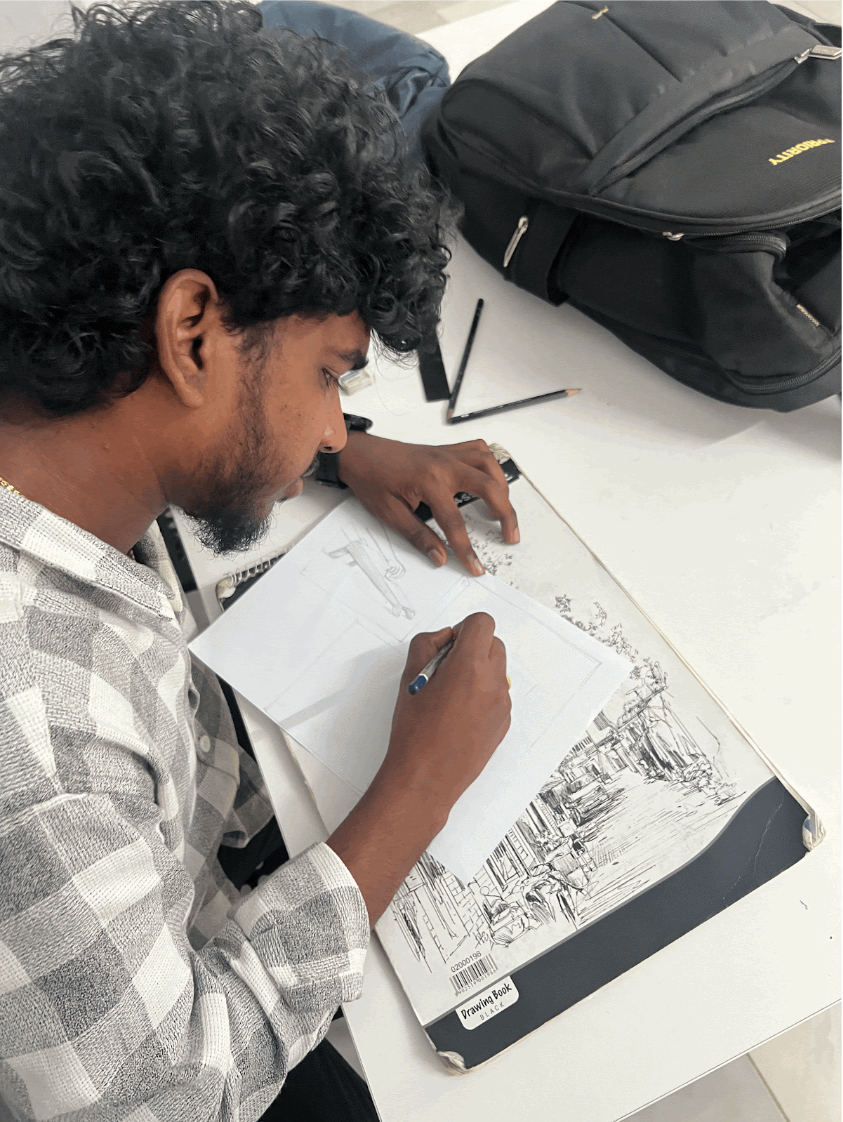
- Put the bulk of your prep time into Part B. With 75% of your final score riding on five drawing/design questions, sustained studio practice matters more here than anywhere else in your preparation.
- Revisit design fundamentals even without a design degree. CEED explicitly welcomes candidates from any discipline, but the exam still expects visual literacy — sketching, composition, and design thinking are learnable even if your undergraduate degree wasn't design-related.
- CEED Practice previous years' Part B papers under timed conditions. Two hours for five design questions requires pacing discipline that's hard to develop without repetition.
- Prepare a portfolio early if you're also targeting interviews at your shortlisted institutes — many M.Des/PhD admissions processes involve a portfolio review or interview after the CEED score stage.
Why a Structured Coaching Programme Helps
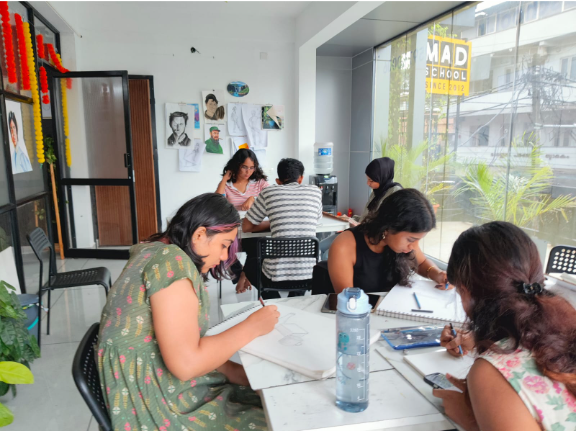
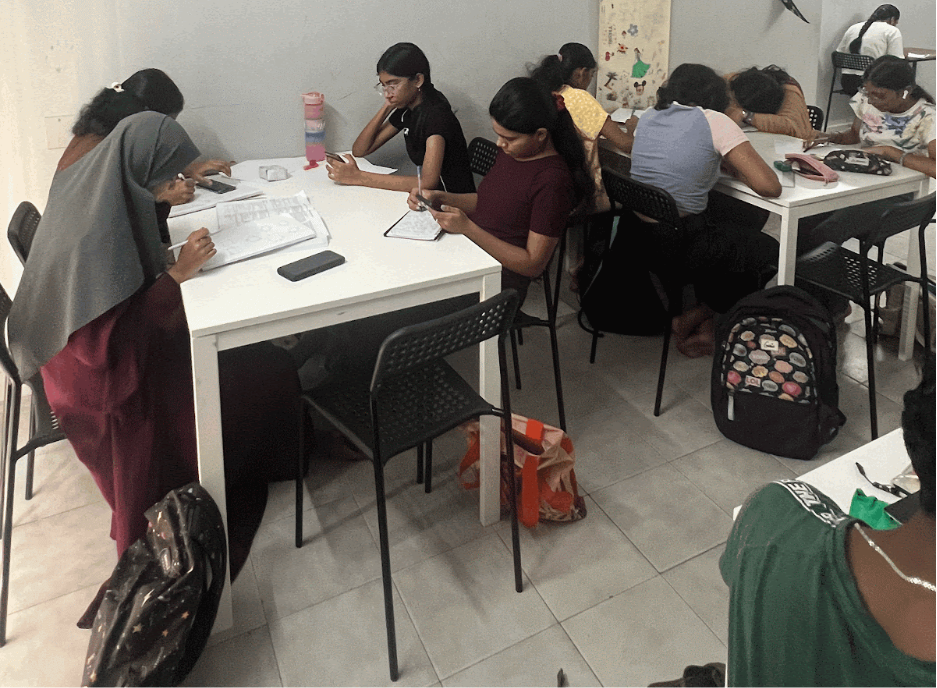
Since Part B carries three-quarters of your final CEED score, generic self-study often isn't enough to build the studio speed and design maturity the exam expects. Mad School's ceed coaching in hyderabad, chennai and Kerala runs a dedicated CEED batch with mentor-reviewed sketching practice, full timed mocks replicating the real Part A/B split, and portfolio guidance for candidates moving on to institute-level interviews.
FAQ's
Yes, January 17, 2027, the same day as UCEED, officially announced by IIT Bombay.
The full notification and application process are expected to open October 1, 2026, at ceed.iitb.ac.in.
No. CEED has no upper age limit and no cap on the number of attempts.
No, CEED gives you an All India Rank, but you must separately apply to each institute's M.Des/PhD programme, each with its own cutoff and selection process (often including a portfolio review or interview).
Yes — any bachelor's degree, diploma, or PG degree of at least 3 years after 10+2 qualifies, along with specific alternatives like BFA or GD Arts Diploma.
CEED is for postgraduate M.Des/PhD admission after a bachelor's degree; UCEED is for undergraduate B.Des admission after Class 12. Both are conducted by IIT Bombay, on the same day.
Explore More Design & Architecture Entrance Exam Guides
- NID DAT 2027: Exam Dates, Registration, Eligibility & Exam Centres — for B.Des and M.Des at the National Institute of Design.
- UCEED 2027: Exam Dates, Registration, Eligibility & Exam Centres — for undergraduate B.Des admission, conducted on the same day as CEED.
- NIFT 2027: Exam Dates, Registration, Eligibility & Exam Centres — for B.Des, B.FTech, M.Des, MFM, and M.FTech at NIFT.
- NATA 2027: Exam Dates, Registration, Eligibility & Exam Centres — for B.Arch admissions through the Council of Architecture.
If you're an NID M.Des aspirant also considering CEED as a backup or parallel option, note the two exams' Mains/Part B stages fall in different months; NID's M.Des Mains around March 2027, versus CEED's institute-level interviews typically in the same window so plan your portfolio prep accordingly.