Last-Minute Tips to Improve Your NID or NIFT Entrance Exam Score

As the NID or NIFT entrance exam gets closer, most students experience a similar mix of emotions.
There is excitement about finally getting to attempt the exam, but there is also anxiety.
"Have I prepared enough?"
"What if the questions are completely different from what I practised?"
"Should I spend the remaining time learning new topics?"
"What if my drawing is not good enough?"
These thoughts are common, especially during the final few weeks before a competitive design entrance examination.
The truth is, the last stage of preparation can still make a meaningful difference to your performance. You may not be able to transform every weakness overnight, but you can improve your exam strategy, speed, accuracy, confidence, and ability to handle unfamiliar questions.
More importantly, you can avoid the mistakes that many students make when they panic and change their entire preparation strategy just before the exam.
Whether you are preparing for NID, NIFT, or both, here are some practical last-minute tips that can help you use your remaining preparation time wisely.
Understand What You Can and Cannot Change at the Last Minute
The first step is being realistic.
You probably cannot develop years of drawing experience in two weeks. You cannot memorise every possible general awareness question overnight. And you certainly cannot practise every creative question that might appear in the examination.
But you can improve several things.
You can:
- Become faster at solving questions.
- Learn to manage your time better.
- Identify recurring mistakes.
- Improve your sketching confidence.
- Practise thinking under pressure.
- Revise important topics.
- Become familiar with different question types.
- Improve the clarity of your visual communication.
The goal of last-minute preparation should therefore be improvement rather than perfection.
Instead of asking, “How can I finish everything?”, ask yourself:
“What are the biggest mistakes currently affecting my score, and how can I reduce them?”
That question can make your remaining preparation much more focused.
Start With an Honest Assessment of Your Preparation
Before creating another study timetable, take a step back and evaluate where you currently stand.
Try dividing your preparation into different areas.
Sketching and Visualisation
Ask yourself:
- Can I draw everyday objects from different angles?
- Can I draw human figures in action?
- Do I understand basic perspective?
- Can I communicate an idea quickly through a sketch?
- Can I create a simple visual story?
Creative Thinking
Think about whether you can:
- Generate multiple ideas for a problem.
- Look at ordinary objects differently.
- Develop unusual but practical solutions.
- Explain your concepts clearly.
Aptitude and Reasoning
Evaluate:
- How quickly can you solve logical questions?
- Do you make careless mistakes?
- Which types of questions take too much time?
Exam Strategy
Finally, ask:
- Do I know how to divide my time?
- Do I spend too long on difficult questions?
- Have I attempted full-length mock tests?
This honest assessment will help you avoid wasting time on areas where you are already reasonably confident.
Don't Start Learning Too Many New Things
One of the most common last-minute mistakes is suddenly collecting more books, YouTube videos, notes, and study materials.
Students sometimes convince themselves that they are missing a secret topic or technique that everyone else knows.
This usually creates more confusion.
The final stage of preparation is not the best time to completely change your approach.
If you already have study material, previous-year questions, mock tests, and practice exercises, use them properly.
Go deeper instead of wider.
For example, instead of watching ten new tutorials on perspective drawing, review your previous perspective sketches and identify exactly what goes wrong.
Do your buildings look flat?
Are your proportions inconsistent?
Are parallel lines converging incorrectly?
Are you spending too much time adding unnecessary details?
Specific improvement is far more valuable than collecting more information.
Previous-Year Questions Should Become Part of Your Daily Practice
Previous-year questions are among the most useful resources available to design aspirants.
They don't guarantee that the same questions will appear again. However, they can help you understand the nature of thinking that the examination expects.
When solving previous papers, don't simply read the question and immediately look for an answer online.
Attempt it seriously.
If possible, use a timer.
After completing the question, analyse your response.
Ask These Questions After Every Practice Session
- Did I understand the question correctly?
- Did I answer every part of the question?
- Was my idea original?
- Was the solution practical?
- Did my drawing communicate the idea clearly?
- Did I spend too much time?
- What would I change if I attempted it again?
This reflection is where much of the learning happens.
Take Mock Tests Under Real Exam Conditions
Mock tests are useful only when you treat them seriously.
Taking a mock test while checking your phone, pausing frequently, or searching for answers defeats the purpose.
Try recreating the actual examination environment as much as possible.
Sit somewhere quiet.
Keep your phone away.
Set the correct time limit.
Keep only the permitted materials around you.
Attempt the paper without interruptions.
The purpose of a mock test is not simply to calculate your score.
It helps you understand how you behave under pressure.
Some students discover that they spend too much time on the first few questions. Others realise they become anxious when they encounter an unfamiliar problem.
It is better to discover these habits during a mock test than during the actual NID or NIFT examination.
Also Read: Top 10 Architectural Colleges In Kerala
Spend More Time Analysing Mock Tests
Many students take mock test after mock test without properly reviewing them.
That is a missed opportunity.
After every mock, spend time categorising your mistakes.
You can divide them into four groups:
Knowledge Mistakes
You didn't know how to approach the question.
Interpretation Mistakes
You misunderstood what the question was asking.
Time Management Mistakes
You knew what to do but ran out of time.
Careless Mistakes
You knew the answer but made an avoidable error.
This helps you understand the difference between needing more knowledge and simply needing better exam discipline.
Keep Sketching, but Change How You Practise
During the final few weeks, sketching should continue to be part of your routine.
However, your practice should become more exam-oriented.
You don't need to spend four hours creating one detailed artwork.
Instead, practise shorter exercises.
Useful Last-Minute Sketching Exercises
Try setting short time limits for:
- Drawing a person walking.
- Drawing someone carrying a heavy object.
- Sketching a crowded street.
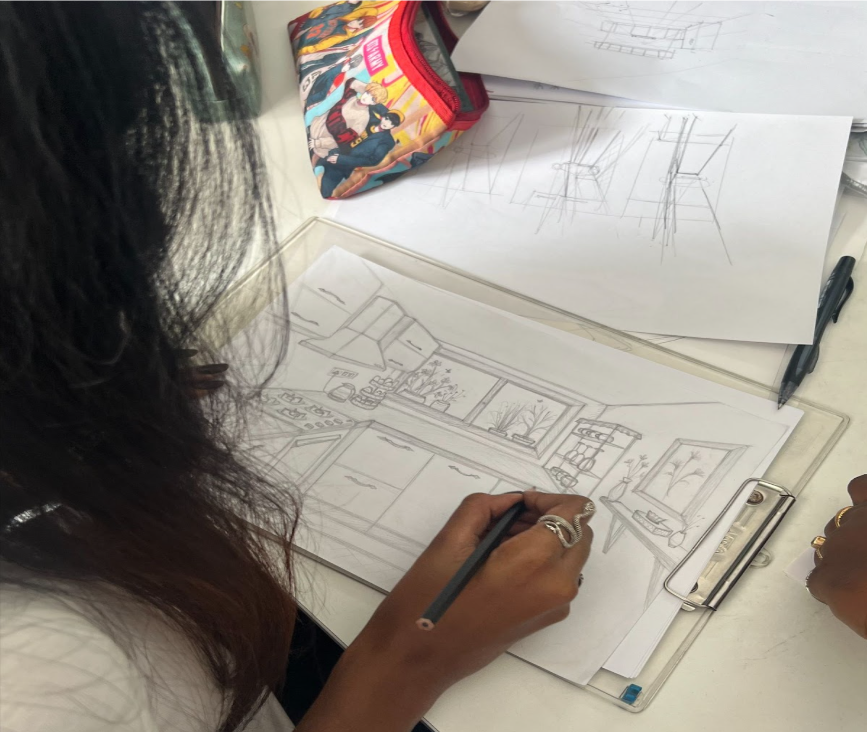
- Drawing a kitchen from memory.
- Visualising a room from another angle.
- Drawing common household products.
- Sketching hands in different positions.
- Drawing people interacting.
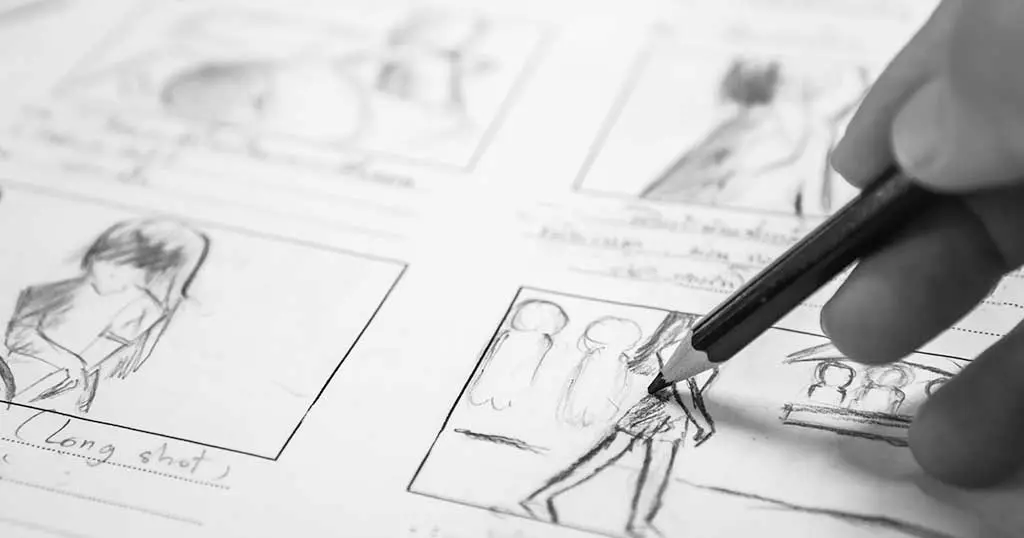
- Creating a three-frame story.
The purpose is to develop speed and confidence.
In a design entrance examination, you are usually communicating an idea within a limited amount of time. Practising short exercises helps prepare you for exactly that situation.
Focus on Communication, Not Just Beautiful Drawings
This is particularly important for students who worry excessively about their artistic ability.
A design entrance exam is not an art exhibition.
The examiner should be able to understand what you are trying to communicate.
A relatively simple drawing with good proportions, clear composition, and a strong idea can often be more effective than an extremely detailed drawing that takes too long to complete.
Pay Attention To
- Proportion
- Perspective
- Composition
- Clarity
- Scale
- Body language
- Expressions
- Visual hierarchy
Before moving on from an answer, look at it quickly and ask:
“If someone saw this without my explanation, would they understand what I am trying to say?”
That is a useful habit for any aspiring designer.
For more assistance, join Hyderabad’s best coaching centre
| NIFT Coaching Centre in Hyderabad | NID Coaching centres in Hyderabad |
| NIFT situation test coaching in hyderabad | Nata coaching institutes in hyderabad |
Improve Your Observation Skills Outside Your Study Table
You don't always need to sit with a book to prepare for a design exam.
Observation can happen throughout the day.
Watch how people stand at a bus stop.
Notice how someone carries a backpack.
Look at the relationship between furniture and people inside a café.
Observe shadows on buildings.
Pay attention to how objects overlap.
Try mentally breaking complex scenes into simple shapes.
Good observation improves drawing, but it also improves design thinking.
Designers often notice problems and details that others overlook.
Practise Thinking About Everyday Problems
Both NID and NIFT aspirants can benefit from developing the habit of questioning everyday experiences.
For example:
Why is this water bottle shaped this way?
Why are supermarket trolleys designed the way they are?
Could this bus stop be more comfortable?
How could an elderly person use this product more easily?
What happens when someone with one hand tries to open this package?
You don't need to create a perfect solution every time.
The exercise is about developing a problem-solving mindset.
Take ordinary objects and situations and ask how they could be improved.
This habit can strengthen your ability to respond to unexpected design questions.
Don't Ignore Aptitude and Non-Drawing Sections
Creative students sometimes spend almost all their preparation time sketching.
That can be risky.
Depending on the examination and the current pattern, non-drawing sections can significantly influence your overall performance.
Keep practising relevant aptitude areas.
This may include:
- Logical reasoning.
- Quantitative ability.
- Visual reasoning.
- Pattern recognition.
- General awareness.
- Analytical thinking.
You don't necessarily need to study these subjects for several hours every day during the final stage.
Even short, regular practice sessions can help maintain speed and confidence.

NIFT Aspirants Should Review Relevant General Awareness Topics
If you are preparing for NIFT, don't leave your general awareness preparation until the last day.
However, avoid the temptation to memorise thousands of unrelated facts.
Focus on important areas and revise what you have already studied.
Relevant Areas May Include
- Fashion.
- Indian textiles.
- Art and culture.
- Famous designers.
- Brands.
- Crafts.
- Fashion history.
- Major national and international events.
- Design-related developments.
Short revision sessions are usually more productive than trying to absorb a massive amount of new information at the last minute.
Learn to Leave Difficult Questions
One difficult question can damage your entire exam strategy if you allow it to consume too much time.
This is easier said than done.
Creative students often become emotionally attached to a difficult drawing or problem. They want to make it perfect.
But competitive exams require strategic decision-making.
If a question is taking too long, ask yourself:
“Is the time I am spending here worth the marks I might gain?”
Sometimes the smartest decision is to move ahead.
You can return later if the exam format allows.
Create a Personal Last-Minute Error List
Instead of writing another long set of notes, create one simple page containing your most common mistakes.
Your list might look something like this:
- Read every question twice.
- Check proportions before adding details.
- Don't spend more than the allocated time on one answer.
- Leave enough time for final review.
- Draw the main idea before adding decoration.
- Avoid unnecessary written explanations.
- Check perspective lines.
- Keep compositions balanced.
Review this list before every mock test.
Over time, these reminders become part of your natural exam behaviour.
Related Reading: Preparing Alongside Class 12
Many students preparing for NID and NIFT are also managing board examinations.
This can make last-minute preparation particularly stressful because there is pressure from multiple directions.
If you are currently in Class 12, you may also find this guide useful:
The article explores how students can balance school academics and design entrance preparation without trying to study everything at once.
Avoid Comparing Your Preparation With Other Students
As the exam approaches, comparison becomes unavoidable.
Someone in your coaching class may say they have completed twenty mock tests.
Another student may share an impressive sketch on Instagram.
Someone else may claim they have been preparing since Class 10.
None of this changes your preparation.
Comparison often creates panic, and panic leads students to make poor decisions.
You may suddenly abandon a strategy that was working.
You may spend time on topics you don't actually need.
You may lose confidence in skills that are already good.
Focus on your own progress.
The only useful comparison is between the work you produced last month and the work you can produce today.
If You Need Feedback, Get It Now
The final stage is a good time to get feedback on your work.
Show your sketches and practice responses to someone who understands design entrance examinations.
Ask specific questions.
Don't simply ask:
"Is my drawing good?"
Instead ask:
- Is the perspective correct?
- Is the composition clear?
- Does the idea communicate effectively?
- What is the biggest weakness in this answer?
- What should I prioritise improving before the exam?
Specific feedback leads to specific improvement.
Students who are enrolled in structured programmes, including NID coaching or NIFT coaching, can use the final weeks to get more value from faculty feedback rather than simply attending more classes.
What Should You Do in the Final Seven Days?
The exact plan will depend on your current preparation level, but a final week could look something like this.
Days 1 and 2: Identify Weaknesses
Review previous mock tests and identify your most common mistakes.
Practise the areas that consistently affect your performance.
Days 3 and 4: Timed Practice
Attempt a full-length or section-based mock test.
Analyse your performance carefully.
Day 5: Focused Creative Practice
Work on sketching, visualisation, storytelling, and creative problem-solving exercises.
Day 6: Light Revision
Review important concepts, previous mistakes, and your personal error list.
Avoid exhausting yourself.
Day Before the Exam
Don't attempt to learn everything.
Check your examination requirements, organise documents, prepare necessary stationery, and get enough sleep.
Your brain needs to be alert more than it needs another five hours of panic-driven revision.
Prepare for the Exam Day, Not Just the Exam
Students often spend months preparing academically but forget about the practical side of examination day.
Check the official instructions carefully and prepare everything in advance.
Make sure you know:
- The examination centre.
- Reporting time.
- Travel route.
- Required documents.
- Identification requirements.
- Permitted stationery or materials.
- Any specific instructions mentioned on the admit card.
Don't leave these details for the morning of the examination.
A calm start to the day can make a significant difference to your mental state.
What to Do When You Encounter an Unexpected Question
There is always a possibility that you will see a question unlike anything you have practised.
Don't immediately assume you are unable to answer it.
Take a breath.
Read the question carefully.
Break it down.
Identify the actual problem.
Think of possible directions before choosing one.
Design entrance exams often test how students respond to unfamiliar situations. An unexpected question may be challenging for everyone in the examination hall.
Your ability to remain calm can become an advantage.
The Importance of Sleep and Mental Preparation
The final few days are not the time to sacrifice sleep.
Creativity requires a functioning, alert mind.
Lack of sleep can affect:
- Concentration.
- Memory.
- Decision-making.
- Speed.
- Mood.
- Problem-solving ability.
Try to maintain a reasonable sleep routine before the examination.
It may feel like you are losing study time, but arriving at the exam exhausted is rarely helpful.
A Final Word for NID and NIFT Aspirants
You don't need to become a perfect designer before entering design school.
That is not the expectation.
You are an aspirant preparing to demonstrate your potential.
Your curiosity matters.
Your ability to observe matters.
Your willingness to think differently matters.
Your ability to communicate an idea matters.
Use the remaining preparation time to strengthen these qualities rather than becoming overwhelmed by everything you haven't done.
Take mock tests seriously. Analyse your mistakes. Practise regularly. Improve your time management. Keep your ideas clear.
And most importantly, trust the work you have already put in.
The exam is one important step in your design journey, but it is not the entire journey.
Frequently Asked Questions
Yes. Major skill development takes time, but focused preparation during the final weeks can still improve speed, accuracy, time management, confidence, and familiarity with different question types.
Regular practice can be helpful, especially for improving speed and confidence. Short, focused exercises are often more useful during the final stage than spending several hours on one detailed drawing.
Not necessarily. Mock tests are most useful when followed by proper analysis. Taking fewer tests and carefully understanding your mistakes can be more productive than taking several tests without reviewing them.
Focus on your weak areas, previous-year questions, sketching fundamentals, visualisation, creative problem-solving, and recurring mistakes identified during mock tests.
Your preparation should include the relevant sections of the current exam pattern, along with regular practice in creative and aptitude-based areas. Review your existing notes rather than trying to memorise large amounts of new information at the last minute.
Stay calm and read the question carefully. Break the problem into smaller parts and think about what it is asking you to communicate or solve. Unfamiliar questions are often designed to test thinking rather than memorisation.
For some students, structured feedback, mock tests, and guidance can be useful during the final stage. However, the value depends on the student's current preparation level and how effectively they use the guidance alongside independent practice.