Is Drawing Important for NIFT, NID, UCEED and CEED? Understanding the Role of Sketching in Design Entrance Exams
One of the most common questions students ask before preparing for design entrance exams is, “Do I need to be good at drawing to become a designer?”
If you enjoy creative activities but struggle to sketch accurately, this question can feel particularly important. You might wonder whether your drawing skills will affect your chances of getting into a good design college or whether you should start learning to draw before beginning your preparation.
The short answer is that drawing is important for several design entrance exams, but the level and type of drawing required vary between examinations and courses. Design aptitude, observation, visualisation, creativity and problem-solving also play important roles.
For example, the National Institute of Fashion Technology (NIFT) uses a Creative Ability Test for its Bachelor of Design admission process. NID has its own Design Aptitude Test, while UCEED and CEED assess drawing alongside other abilities in their respective examination structures. The exact requirements depend on the exam and admission year.
This guide explains the role of drawing in NIFT, NID, UCEED and CEED, the skills you should practise, and how drawing requirements differ across fashion design, interior design, graphic design, animation and architecture.

Is Drawing Important for Design Entrance Exams?
Yes, drawing can be an important part of design entrance preparation. However, design drawing is not necessarily the same as making a realistic portrait or creating a detailed piece of artwork.
In design, drawing is often used to communicate an idea. A student might sketch a new product, show how a person uses an object, illustrate a scene, explore a garment silhouette or explain how a space could be arranged.
The purpose is to make an idea understandable.
For entrance exams, students may need to demonstrate skills such as:
- Observation: Noticing details, proportions, shapes and relationships between objects.
- Visualisation: Imagining an object, scene or situation and representing it visually.
- Perspective: Showing depth and spatial relationships.
- Proportion: Drawing objects and people with reasonably accurate relative sizes.
- Composition: Arranging elements so that the drawing communicates the intended idea clearly.
- Creativity: Developing original and relevant concepts rather than reproducing familiar examples.
- Visual communication: Making the intended message or solution easy to understand.
Not every examination assesses all these skills in the same way. Some questions require drawing directly, while others test design aptitude through objective questions, reasoning or problem-solving.
The goal is not to become a professional artist before taking an entrance exam. It is to develop the skills required to communicate your ideas clearly within the format and time limits of the examination.
Is Drawing Important for NIFT?
Yes. Drawing and illustration skills are relevant to the NIFT Bachelor of Design admission process, particularly through its Creative Ability Test (CAT).
NIFT's entrance process differs according to the programme. Students applying for B.Des should not assume that the admission requirements are identical to those for B.F.Tech. Always refer to the official prospectus for the relevant admission year.
What drawing skills should NIFT aspirants develop?
Students preparing for the B.Des admission process should practise the visual and creative skills relevant to the current examination requirements, including:
- Creative illustration and visual storytelling
- Idea development and concept representation
- Composition and use of space
- Colour and visual communication, where required
- Observation and interpretation of everyday situations
- Communicating an idea within a limited time
For example, a practice question might ask you to develop a visual response to a situation or communicate a concept through an illustration. In such tasks, the idea and how effectively you communicate it matter alongside the drawing itself.
A highly detailed drawing may not communicate a weak idea effectively. Similarly, a relatively simple illustration can be successful if it communicates the concept clearly and meets the question's requirements.
How can you improve drawing for NIFT?
Start by sketching everyday objects, clothing, people in simple poses and familiar surroundings. Practise creating different concepts from the same theme rather than repeatedly copying a single reference image.
Work on the relationship between your idea and your illustration. Ask yourself whether someone looking at your drawing can understand what you are trying to communicate.
Timed practice is also important because entrance examinations require students to develop and present ideas within a limited period.
Is Drawing Important for NID?
Yes. Drawing and visualisation are relevant to NID entrance preparation, but students should understand that the examination is not simply a test of artistic ability.
The National Institute of Design conducts the Design Aptitude Test (DAT) for its design programmes. The examination structure and selection stages can vary according to the programme and admission year.
NID preparation involves developing a broader set of abilities, including observation, creative thinking, design sensitivity, problem-solving and visual communication.
What drawing skills are useful for NID?
Students should develop the ability to:
- Sketch objects and scenes with understandable proportions.
- Represent basic three-dimensional forms.
- Communicate ideas through simple illustrations.
- Show how people interact with objects or environments.
- Develop original visual solutions to a problem.
- Arrange elements effectively within a composition.
- Use perspective and visual details where they improve communication.
Consider a question asking you to design a useful object for a particular situation. A successful response may need to communicate the object's shape, its purpose and how a person would use it.
This requires more than drawing an attractive object. You must also understand the problem and develop a suitable solution.
Related: How to prepare for drawing, sketching and visualisation for NID Studio Test?
How can you prepare for NID drawing questions?
Begin with observation exercises. Choose an everyday object and sketch it from different angles. Notice its proportions, structure, material and details.
Next, practise drawing objects in context. For example, instead of sketching a chair by itself, draw a person sitting on it in a simple room setting.
Gradually move to timed design problems. Give yourself a specific task, develop more than one idea and select the most appropriate solution.
The aim is to make your thinking visible through your drawing.
Is Drawing Important for UCEED?
Yes. Drawing is explicitly included in UCEED Part B.
According to the official UCEED 2027 syllabus, drawing assesses the ability to draw products, people or scenes with attention to line quality, composition, proportion, perspective and shading. Part B also assesses design aptitude. https://www.uceed.iitb.ac.in/2027/syllabus.html
UCEED has two parts. Part A assesses areas such as visualisation and spatial reasoning, observation and design sensitivity, analytical reasoning and creativity. Part B assesses drawing and design aptitude.
This means students should not spend all their preparation time practising sketches while ignoring the other parts of the examination.
What drawing skills should UCEED aspirants practise?
Focus on:
- Drawing objects and people in proportion
- Understanding perspective and depth
- Creating clear, controlled lines
- Using light and shading to communicate form
- Arranging elements within a composition
- Representing a scene in a way that is easy to understand
- Managing time while developing a complete drawing
UCEED drawing questions may require you to communicate a visual situation clearly. The official syllabus identifies line quality, composition, proportion, perspective and shading as relevant drawing abilities.
Is artistic drawing enough to score well in UCEED?
No. Drawing is one component of the examination, not the entire examination.
A student who draws well but neglects observation, reasoning, visualisation and design aptitude may leave important areas of preparation uncovered.
A balanced preparation plan should include Part A practice, drawing exercises, design aptitude questions and regular review of official previous question papers.
You can refer to the official UCEED 2027 syllabus to understand the stated examination topics.
Is Drawing Important for CEED?
Yes. Drawing is explicitly assessed in CEED Part B, alongside design and writing skills. The official CEED 2027 examination information states that Part A assesses design aptitude-related abilities, while Part B evaluates design, drawing and writing skills. https://www.ceed.iitb.ac.in/2027/
However, there is an important distinction: CEED is primarily an entrance examination for postgraduate design programmes, not an undergraduate entrance exam directly after Class 12.
Students completing Class 12 who want to pursue an undergraduate design degree should investigate examinations such as UCEED, NID DAT, NIFT's relevant admission process and other institution-specific routes. CEED is generally relevant later, when planning for postgraduate design education.
What drawing skills are useful for CEED?
Depending on the question, students may need to demonstrate:
- Visualisation and spatial understanding
- Clear sketching and representation
- Design concept development
- Problem-solving through visual communication
- Understanding of form, proportion and composition
- The ability to communicate design ideas in writing as well as visually
CEED preparation should be based on the current examination structure and the requirements of the postgraduate programmes you intend to pursue.
Students should also remember that qualifying for CEED does not automatically guarantee admission to a particular institute. Individual institutions may have additional selection requirements.

NIFT vs NID vs UCEED vs CEED: How Important Is Drawing?
The following comparison provides a general overview. The precise examination format and selection process should always be verified using the official information for your admission year.
| Entrance exam | Who typically considers it? | Role of drawing |
|---|---|---|
| NIFT | Students applying for relevant NIFT programmes, including B.Des | Creative illustration and visual skills are relevant to the B.Des CAT |
| NID DAT | Students applying to specified NID design programmes | Drawing, visualisation and creative problem-solving are relevant to design aptitude assessment |
| UCEED | Students seeking admission to participating undergraduate B.Des programmes | Drawing is explicitly assessed in Part B |
| CEED | Students planning to apply for postgraduate design programmes | Drawing, design and writing skills are assessed in Part B |
The main takeaway is that drawing matters, but the way it is assessed differs. Prepare for the examination you intend to take instead of following a single drawing routine for every design entrance exam.
What Type of Drawing Should You Practise for Design Entrance Exams?
If you are new to drawing, you do not need to start with complicated portraits or elaborate artwork. Begin with fundamental skills and build gradually.
1. Basic Shapes and Forms
Practise drawing circles, cubes, cylinders, cones and simple combinations of shapes. These forms help you understand how everyday objects can be represented in two dimensions.
For example, a bottle may be built from cylindrical forms, while a box can be understood through basic rectangular forms.
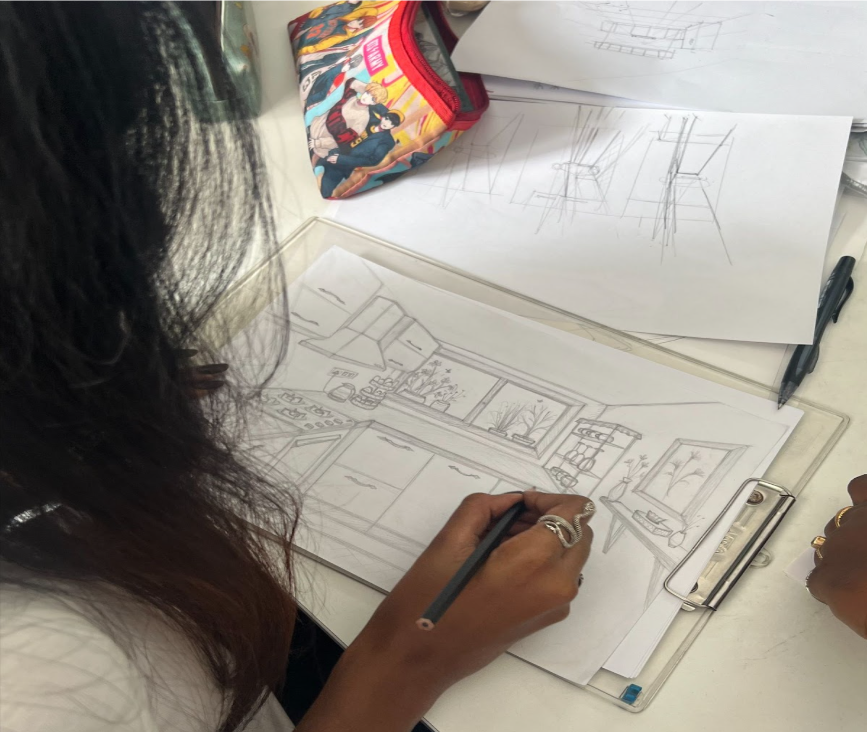
2. Perspective Drawing
Perspective helps you represent depth and the relative positions of objects. Practise drawing simple rooms, streets, furniture and objects from different viewpoints.
You do not need to create architectural drawings for every exercise. Start by understanding how parallel lines and visible surfaces change with the viewing angle.
3. Proportion and Observation
Choose a familiar object and study its height, width, shape and distinctive features before sketching it.
Compare the relative sizes of different parts. If you are drawing a person using a chair, pay attention to the relationship between the person's body and the furniture.
Observation helps you avoid relying entirely on symbols or assumptions when drawing.
4. Human Figures and Movement
People appear in many design-related drawing tasks. Practise simple human figures in standing, sitting, walking and working positions.
Begin with basic body shapes and gesture lines. Gradually add clothing, posture and context.
The goal is to communicate the person's activity and position, not necessarily to produce a realistic portrait.
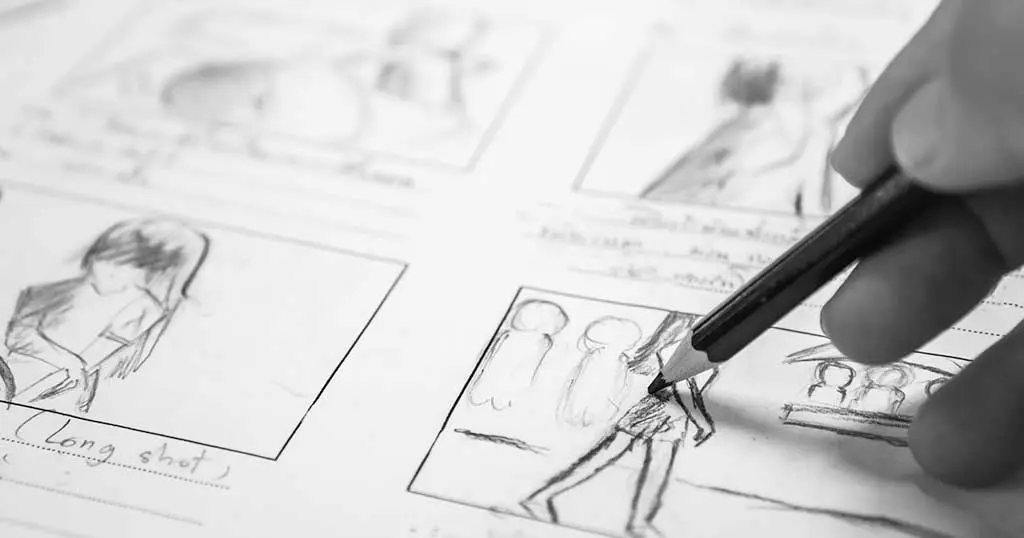
5. Composition and Visual Storytelling
Composition is the way elements are arranged within a drawing. A clear composition helps viewers understand what is happening and where they should look first.
Practise illustrating simple situations, such as a student working at a desk, a person using public transport or a family interacting in a room.
Think about foreground, background, placement and the main action.
6. Shading and Line Quality
Shading can help communicate volume, material and light. Practise using light and dark areas to distinguish the visible surfaces of basic objects.
Line quality matters too. Use lines deliberately to communicate structure rather than repeatedly outlining the same shape.
The amount of shading or detail required depends on the question. Avoid spending too much time on decorative details when the main concept is still unclear.
7. Timed Drawing Practice
Drawing for an entrance exam is different from drawing at your own pace.
Set a time limit for each exercise. Plan the main idea, sketch the basic structure, add essential details and review the final result.
After finishing, check whether your drawing answers the question, communicates the intended idea and uses the available space effectively.
How to Improve Drawing Skills If You Are a Beginner
If you currently struggle with drawing, the best approach is consistent practice rather than trying to improve everything in a few days.
Here is a simple routine you can adapt to your preparation schedule.
Step 1: Practise basic forms. Spend a few minutes drawing simple objects and shapes. Concentrate on proportions and structure.
Step 2: Observe before drawing. Study the object or scene carefully. Identify its main shapes, proportions and distinguishing features.
Step 3: Practise one skill at a time. Work on perspective, human figures, composition or shading in separate exercises before combining them.
Step 4: Solve a design problem. Choose a simple problem and sketch a possible solution. For example, design a school bag with a useful feature for students.
Step 5: Review your work. Identify what is unclear or inaccurate. Compare your drawing with the task requirements rather than judging it only by how attractive it looks.
Step 6: Practise under time limits. As your confidence improves, complete questions within a set time and review your progress.
A short, consistent routine is usually more useful than practising intensively for one day and then stopping for a week.
Related: List of Design courses to choose from after 12th
Common Drawing Mistakes Students Should Avoid
Trying to make every drawing look perfect
Entrance exam drawing is about responding to a question effectively. Spending too long polishing one small area can prevent you from completing the overall response.
Ignoring the question
A visually impressive drawing may still be ineffective if it does not answer the prompt. Read the question carefully and identify the main requirements before starting.
Copying instead of observing
Copying references can help beginners understand forms, but design entrance preparation also requires original thinking. Practise drawing from observation and creating your own responses to different situations.
Adding too many details
Details should support the idea. Begin with the overall composition and structure, then add the elements necessary to communicate the concept.
Neglecting other exam components
Drawing is important in several examinations, but it is not the only skill being assessed. Follow the complete syllabus and practise reasoning, observation, creativity and other relevant areas.
Is Drawing Important for Different Design Courses?
Drawing requirements also vary according to the design course you want to pursue. Here is how drawing can be useful in some popular design fields.
Fashion Design
Drawing helps fashion designers communicate garment silhouettes, proportions, details and styling ideas. Fashion illustration can be useful, but students also need to understand fabrics, construction, materials and the intended purpose of a design.
Interior Design
Drawing helps interior designers communicate room layouts, furniture placement, spatial relationships and design concepts. Technical drawing and digital visualisation may also form part of the course.
Graphic Design
Drawing can support illustration, visual exploration and concept development. However, graphic design also involves typography, layout, colour, branding and digital tools. Strong drawing skills are not a universal prerequisite for every graphic design role.
Animation
Drawing is particularly useful in areas such as 2D animation, character design and storyboarding. Other animation roles may focus more on 3D modelling, rigging, lighting or technical workflows. The importance of drawing depends on the role and programme.
Architecture
Drawing is useful for communicating spaces, forms and design ideas. Architecture education also involves spatial reasoning, technical knowledge, building systems and design development. Admission requirements vary, so students should check the current B.Arch eligibility and examination rules rather than assuming all architecture courses assess drawing in the same way.
Frequently Asked Questions
Yes, drawing is relevant to these examinations, but the format differs. NIFT's B.Des process includes a Creative Ability Test, UCEED explicitly assesses drawing in Part B, and CEED assesses drawing, design and writing skills in Part B. NID's Design Aptitude Test evaluates a broader range of design-related abilities, with requirements depending on the examination stage and programme.
You can work towards improving the skills required for the relevant NIFT admission process. For B.Des aspirants, creative illustration and visual communication are important areas to practise. Check the official prospectus for the current examination structure and selection requirements, and build a preparation plan around them.
Yes, drawing can help fashion designers communicate clothing concepts, silhouettes, proportions and details. However, fashion design also involves textiles, garment construction, materials, research and product development. You do not need to be an expert artist to begin learning fashion design, but you should be willing to develop the relevant visual skills.
Yes, drawing is useful for communicating layouts, spatial arrangements, furniture placement and interior concepts. Students may also learn technical drawing and digital visualisation. The drawing requirements for admission depend on the particular course and institution.
Drawing is useful for illustration, brainstorming and developing visual concepts, but it is not the only skill involved in graphic design. Typography, composition, colour, layout, branding and digital design tools are also important. Some graphic design programmes place more emphasis on drawing than others.
Drawing is particularly helpful for 2D animation, character design, gesture drawing and storyboarding. In 3D animation, the role of drawing depends on the specialisation, although visual observation, form and composition remain useful. Students should review the curriculum of the animation programme they are considering.
Drawing is useful for representing buildings, spaces, proportions and design concepts. However, architecture also involves spatial reasoning, technical understanding and design development. Students applying to B.Arch programmes in India should check the current eligibility and admission requirements, including the applicable NATA or JEE Main Paper 2 route.
Yes. Many students begin developing their drawing skills during entrance exam preparation. Start with basic forms, observation, proportion and visualisation, then progress to timed practice relevant to your target examination.
There is no single schedule that suits every student. A consistent daily practice session can be useful, but the duration should depend on your current ability, preparation timeline and other examination subjects. Review your progress regularly and increase the complexity of your exercises gradually.
Neither should be treated as a replacement for the other. Drawing helps communicate an idea, while creativity helps generate original and relevant ideas. The relative importance of different skills depends on the examination and the question being assessed.
Not necessarily. Begin with the skills relevant to your target examination, such as observation, proportion, perspective, composition and clear visual communication. Realistic drawing can be useful in some contexts, but it is not the only way to demonstrate design thinking.
No. CEED is primarily intended for admission to postgraduate design programmes. Students seeking undergraduate design admission after Class 12 should explore relevant routes such as UCEED, NID DAT, NIFT's admission process and other institution-specific examinations.
Conclusion
Drawing is an important skill in several design entrance exams and design-related courses, but it is only one part of a much broader set of abilities.
You do not need to produce perfect artwork before you begin preparing. What matters is understanding the requirements of your target examination, practising the relevant skills and learning how to communicate ideas clearly.
Start with observation, basic forms, proportion, perspective and composition. Gradually move to design problems and timed exercises. At the same time, prepare for the other areas included in your examination syllabus.
If you are preparing for NIFT, NID, UCEED or another design entrance exam, MAD School can help you explore structured preparation options relevant to your target course. The first step is to understand the examination you are aiming for and build a preparation plan around its requirements.
Ready to start your dream career?