How to Prepare for Sketching, Visualisation, Doodling, and Rapid Sketching for the NID Studio Test
Preparing for the NID Studio Test can feel confusing, especially when students realise that it is very different from the written entrance exam. Many aspirants walk into this round assuming that better drawing skills alone will help them clear it. In reality, the Studio Test is not about how well you draw — it is about how you think, interpret, and communicate ideas visually under pressure.
The Studio Test evaluates a student’s ability to respond to open-ended tasks using sketching, visualisation, quick ideation, and creative problem-solving. This is where NID looks beyond scores and ranks to understand whether a candidate truly has the mindset required for design education.
This article explains how to prepare for sketching, visualisation, doodling, and rapid sketching for the NID Studio Test in a practical, realistic way — especially for students who feel they are “not good at drawing” but want to prepare correctly.

Understanding What the NID Studio Test Is Actually Testing
Before jumping into preparation, it’s important to understand why these sections exist in the first place.
The NID Studio Test is designed to assess:
- Your ability to think visually
- How quickly you can generate and communicate ideas
- How you approach unfamiliar problems
- Your observation and interpretation skills
- Your comfort with ambiguity
Unlike school exams, there are no model answers. Two students can approach the same task completely differently and still perform well if their thinking is clear and purposeful.
Sketching, visualisation, doodling, and rapid sketching are not separate talents — they are tools NID uses to see your thinking process.
Sketching for the NID Studio Test: What It Really Means
What NID Expects from Sketching
Sketching in the NID Studio Test is not about realism, shading, or artistic perfection. It is about clarity.
NID expects you to:
- Show ideas clearly
- Explain functions, usage, or interaction
- Communicate concepts visually
- Support your thinking with simple drawings
Clean line sketches that explain an idea are far more valuable than detailed, decorative drawings that say nothing.
How to Prepare for Sketching
When students hear “sketching” in design exams, many immediately think of artistic talent, or perfect drawings. That assumption often creates unnecessary fear. In reality, sketching for design entrance exams is about communication, not decoration.
Good sketching helps you explain ideas quickly, clearly, and confidently—especially under time pressure. Preparation, therefore, should focus on clarity, intent, and speed, not artistic polish.
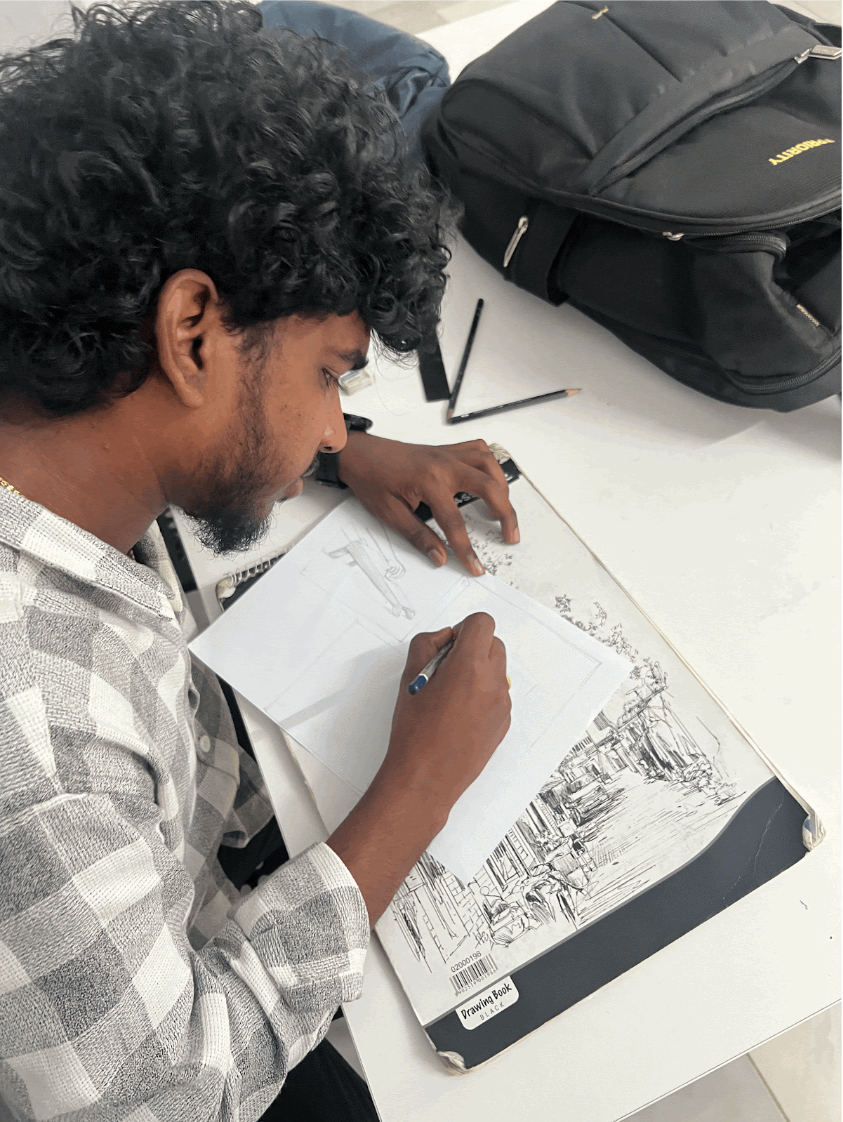
1. Practise functional sketching
Design exam sketching is functional. That means every sketch should serve a purpose. While practising, Sketch objects being used, not just standing alone. Show interaction between people and objects and Focus on function over form.
For example, instead of drawing a bottle neatly, sketch:
- A person holding it
- How it is opened or poured
- Where it is used
This immediately makes your sketch more relevant to design exams.
2. Practise Simple lines and shapes
Most strong design sketches are built using basic shapes.
To practise:
- Break objects into circles, rectangles, and cylinders
- Avoid unnecessary detailing
- Use clean, confident lines
Repeated erasing, heavy shading, or outlining again and again often signals hesitation. One confident line—even if imperfect—is better than many corrected ones.
2. Sketch Ideas, Not Just Objects
Design exams often test idea generation, not object drawing.
Practise sketching:
- Concepts
- Solutions
- Situations
For example:
- How would you show “safety,” “comfort,” or “crowding” visually?
- How would you sketch a solution to a real-life problem?
This prepares you for open-ended studio test prompts.
3. Observe Real Life and Sketch from It
The best sketching practice comes from observation.
Try:
- Sketching people at bus stops, cafés, or parks
- Drawing everyday interactions
- Noticing posture, movement, and space
Design exams reward students who observe life closely, not those who memorise styles.

Preparing for sketching is not about becoming an artist. It’s about becoming a clear visual communicator. When your sketches explain ideas quickly and confidently, you are already meeting what design entrance exams expect. If you practise with purpose—focusing on thinking, clarity, and speed—your sketching will improve naturally and effectively.
Related: How to Improve Your Visualisation Skills for the NID Studio Test and NIFT Situation Test
Visualisation: Think Before You Draw
What Visualisation Means in the Studio Test
Visualisation is your ability to mentally imagine situations, transformations, or outcomes and express them visually. This may include:
- Imagining how an object changes shape
- Showing before-and-after scenarios
- Visualising how a system works
- Interpreting abstract prompts into visual ideas
This skill is critical because designers often solve problems before anything exists physically.
How to Improve Visualisation Skills
1. Practise scenario-based thinking
One of the most common mistakes students make while preparing for design entrance exams is focusing on drawing individual objects in isolation. While object sketching helps improve hand control, it does not fully prepare you for how NID Studio Test and NIFT Situation Test questions are framed.
These exams are not interested in how well you can draw a chair, a bottle, or a bag by itself. They are interested in how you understand situations, contexts, and human needs, and how you visually respond to them.
That is why learning to think in scenarios, rather than objects, is crucial.
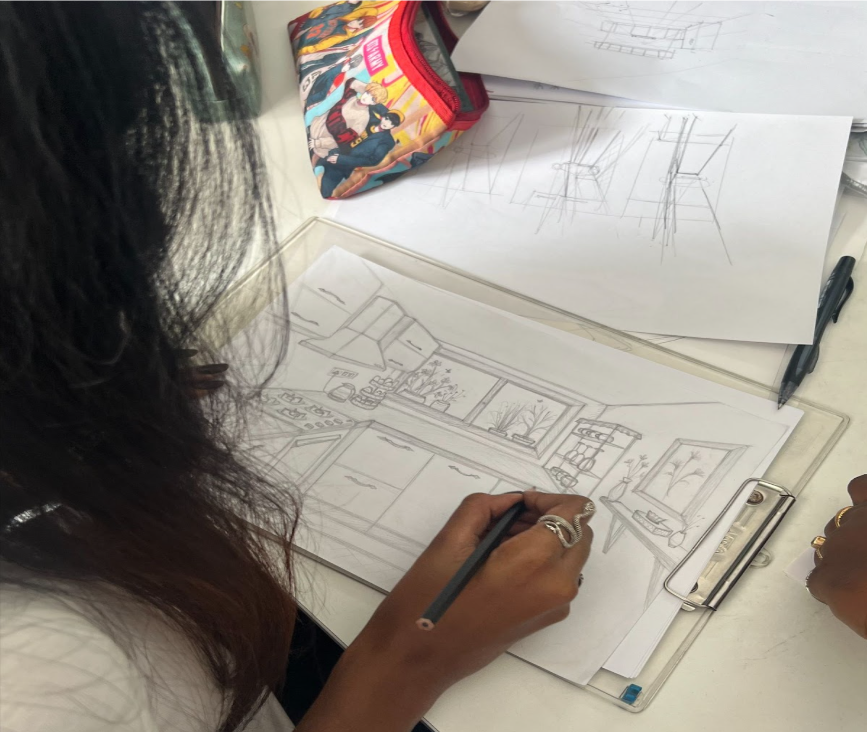
2. Use step-by-step sketches
Both NID and NIFT value process-oriented thinking. A single sketch often cannot explain a complex idea.
Train yourself to:
- Break ideas into steps
- Use multiple small frames
- Show progression or transformation
Sequence sketches help examiners quickly understand:
- How your idea works
- Why it exists
- What changes it brings
This is especially important in the NIFT Situation Test, where clarity and organisation matter a lot.
3. Practise mental rotation
Visualisation also includes the ability to imagine objects from different angles.
Exercises to improve this:
- Pick an everyday object and sketch it from three viewpoints
- Visualise how it looks when opened, folded, or moved
- Practise basic perspective without over-detailing
This helps in tasks where you need to explain form, structure, or space.
4. Translate words into visuals
Both exams often give verbal prompts that need to be converted into visual solutions.
To practise:
- Take a sentence from a newspaper or signboard
- Imagine it as a visual story
- Sketch how that idea might appear in real life
This builds confidence in handling abstract prompts — a common challenge in the Studio and Situation Tests.
Doodling: Why NID Takes It Seriously
What Doodling Means
Doodling is often misunderstood as random drawing. In the context of the NID Studio Test, doodling is about free idea generation.
It shows:
- How you explore ideas quickly
- Your comfort with experimentation
- Your ability to think without over-planning
NID values doodling because it reflects how designers actually think in the early stages of problem-solving.
How to Practise Doodling the Right Way
1. Doodle ideas, not objects
- Use doodles to explore concepts
- Don’t aim for clean drawings
2. Practise timed doodling
- Set a timer for 5–10 minutes
- Generate as many visual ideas as possible
3. Don’t judge while doodling
- Evaluation comes later
- Focus on flow, not quality
4. Use symbols and icons
- Simple visual shorthand is effective
- Avoid over-detailing
Rapid Sketching: Speed with Clarity
Why Rapid Sketching Is Important
The Studio Test is time-bound. NID wants to see whether you can:
- Think quickly
- Make decisions without overthinking
- Communicate ideas under pressure
Rapid sketching doesn’t mean rushing. It means efficient communication.
How to Train for Rapid Sketching
1. Set strict time limits
- 30 seconds to 2 minutes per sketch
- Practise daily with a stopwatch
2. Reduce hesitation
- Avoid erasing too much
- One confident line is better than many corrections
3. Practise everyday themes
- Transport
- Public spaces
- Household objects
- Human interactions
4. Focus on key elements
- What is essential to explain the idea?
- Remove everything else
Common Mistakes Students Make
- Trying to impress with artistic detail
- Spending too much time on one sketch
- Copying styles from social media
- Panicking when prompts feel vague
- Treating the Studio Test like a drawing exam
The Studio Test is not about showing what you know — it is about showing how you think.
Practical Preparation Tips for Students
- Practise thinking out loud on paper
- Keep a sketchbook for ideas, not finished work
- Review your sketches and ask: “Does this explain my idea?”
- Observe how people use objects and spaces
- Stay calm — ambiguity is part of the test
How Parents Can Support Students Preparing for the Studio Test
Parents often worry when they see messy sketches or abstract tasks. It’s important to understand that:
- Messy sketches are part of idea development
- Improvement is gradual
- Confidence matters as much as skill
Support, patience, and realistic expectations go a long way.
Preparing for the NID Studio Test with the Right Guidance
Preparing for the NID Studio Test requires more than practising sketches at home. Students benefit most when they receive structured feedback, clarity on evaluation, and guided practice under exam-like conditions.
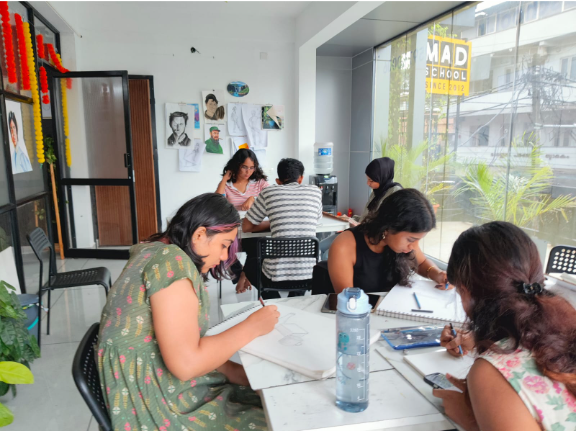
MAD School provides nid coaching and NID Studio Test Coaching in Hyderabad, Chennai and Kerala. It mainly focuses on helping students understand why certain approaches work, not just what to draw. Through regular studio-style exercises, mock tests, and personalised feedback, students learn to improve their sketching, visualisation, doodling, and rapid sketching skills in a way that aligns with NID’s expectations.
For students who have cleared the NID written exam and want to approach the Studio Test with confidence and clarity, MAD School provides focused guidance designed specifically for this stage of the selection process.
Final Thought
The NID Studio Test is not meant to intimidate students. It is designed to identify thinkers, problem-solvers, and curious minds. With the right preparation approach, clarity of purpose, and consistent practice, students can perform well — even if they don’t consider themselves “good at drawing”.
If you prepare to think visually, rather than just draw well, you’re already on the right path.
| NIFT Coaching Hyderabad | NIFT Coaching Annanagar, Chennai |
| NIFT Coaching, Ernakulam Kerala | NIFT Coaching Bangalore |