NIFT Entrance Exam 2026: Important Dates, Courses, Criteria, Exam Pattern, Admit Card, Fees, Preparation Tips
If you dream of studying at India’s top fashion institute, the National Institute of Fashion Technology (NIFT), then the NIFT Entrance Exam 2026 is your gateway.
Every year, thousands of students apply to NIFT hoping to enter the world of fashion design, technology, communication, management and creative arts.
This comprehensive guide covers every detail you need to know — dates, eligibility, courses, exam pattern, how to apply, documents, admit card, results, career opportunities and preparation tips.
NIFT 2026 Important Dates
- Online Registration Starts: 08 December 2025
- Last Date to Apply: 06 January 2026
- Late Fee Application Window: 07 – 10 January 2026
- Application Edit / Correction Window: 12 – 14 January 2026
- Admit Card Release: 3rd Week of January 2026
- Entrance Exam (UG & PG): 08 February 2026
- Answer Key (GAT): February 2026
- Result Declaration: March / April 2026
- Situation Test / Interview / Studio Test: April / May 2026
- Final Result: May 2026
- Seat Allocation: May – June 2026
How to Apply: Application is online via NIFT’s official portal as listed on its website.
Courses Offered at NIFT
NIFT offers Undergraduate, Postgraduate, and Continuing Education (CE) programmes across Design, Technology, and Management.
Undergraduate Programmes (UG)
Bachelor of Design (B.Des)
A 4-year design degree offering the following specialisations:
- Fashion Communication (FC)
- Fashion Design (FD)
- Textile Design (TD)
- Knitwear Design (KD)
- Accessory Design (AD)
- Leather Design (LD)
- Fashion Interiors (FI)
Each specialisation combines creative thinking, technical skills, industry exposure, and hands-on projects, preparing students for diverse career opportunities in the fashion and lifestyle industry.
Bachelor of Fashion Technology (B.FTech) - 4 Years
The B.F.Tech programme at NIFT is a 4-year undergraduate degree focused on the technical and managerial aspects of the fashion and apparel industry. It is ideal for students interested in manufacturing, production, quality control, supply chain, and apparel technology rather than core fashion design.
The programme combines technology, engineering principles, and fashion industry practices, with strong exposure to industrial training, internships, and industry-linked projects, preparing students for roles in apparel production and fashion operations.
Ideal for students who:
- Are interested in the technical side of fashion
- Prefer process, systems, and management
- Want careers in apparel manufacturing and technology
Focus areas: Apparel Production, Garment Technology, Manufacturing Management, Quality Control.
Master & Doctoral Programmes at National Institute of Fashion Technology
Master Programmes (2 Years)
M.Des – Master of Design
Advanced design education focusing on innovation, research, design strategy, and
interdisciplinary practice.
MFM – Master of Fashion Management
Designed for students interested in fashion business, retail, marketing, supply
chain, and brand management.
M.F.Tech – Master of Fashion Technology
Focuses on advanced apparel technology, production systems, quality management,
and technical leadership in the fashion industry.
Doctoral Programme
Ph.D – Doctor of Philosophy
Research-based programme for scholars pursuing advanced studies in design,
textiles, fashion, and allied disciplines.
A Quick Glance in Table Format
Programmes & Specialisations at National Institute of Fashion Technology (NIFT)
| Programme | Duration | Specialisations |
|---|---|---|
| B.Des | 4 Years | Fashion Design (FD), Fashion Communication (FC), Textile Design (TD), Knitwear Design (KD), Accessory Design (AD), Leather Design (LD), Fashion Interiors (FI) |
| B.F.Tech | 4 Years | Apparel Production, Fashion Technology |
| M.Des | 2 Years | Advanced Design, Interdisciplinary Design |
| MFM | 2 Years | Fashion Management, Retail & Business Management |
| M.F.Tech | 2 Years | Advanced Apparel Technology, Production & Quality Systems |
| Ph.D | Research Based | Design, Fashion, Textiles & Allied Areas |

NIFT Eligibility Criteria
The eligibility for NIFT varies depending on whether you are applying for Undergraduate (UG) or Postgraduate (PG) programmes.
Bachelor of Design (B.Des) Programmes
(Fashion Design, Leather Design, Accessory Design, Textile Design, Knitwear Design, Fashion Communication)
Candidates must have any one of the following educational qualifications:
- Passed the Plus 2 (10+2) examination from any recognised Central or State board (CBSE / ICSE / ISC / State Boards).
- Passed the Senior Secondary School Examination conducted by the National Institute of Open Schooling (NIOS) with a minimum of five subjects.
- Passed any Public School/Board/University Examination in India or abroad recognised by the Association of Indian Universities (AIU) as equivalent to the 10+2 system.
- Qualified the General Certificate Education (GCE) Examination (London/Cambridge/Sri Lanka) at the Advanced (A) Level.
- Passed the International Baccalaureate (IB) Diploma.
Age Limit:
- Maximum age: 24 years as on 1st August 2026.
- Relaxation of 5 years for SC/ST/PwD candidates.
Note for Students Appearing in 2026:
Students appearing for their Class 12 exams in 2026 are also eligible to apply, but admission will be confirmed only after submission of valid proof during counselling.
Bachelor of Fashion Technology (B.FTech) Programme
(Apparel Production)
Candidates must have Physics and Mathematics as compulsory subjects in Class 12 and meet any one of the following qualifications:
- Passed the 10+2 examination from any recognised Central/State board with Physics and Mathematics.
- Passed the NIOS Senior Secondary School Examination with at least five subjects, including Physics and Mathematics.
- Passed any Public School/Board/University Examination in India or abroad recognised by AIU as equivalent to 10+2 with Physics and Mathematics.
- Qualified the GCE (London/Cambridge/Sri Lanka) at the Advanced (A) Level with Physics and Mathematics.
- Passed the International Baccalaureate (IB) with Physics and Mathematics as subjects.
Age Limit:
Maximum age: 24 years as on 1st August 2026
5-year relaxation available for SC/ST/PwD candidates.
Note for Students Appearing in 2026:
Candidates appearing for their Class 12 board exams in the year of admission can also apply, but they must satisfy all eligibility criteria during counselling.
Eligibility for Master’s Programmes (M.Des, MFM, M.FTech) – NIFT 2026
This section outlines the official eligibility criteria for all postgraduate programmes offered at NIFT. These requirements apply to the 2026 admission cycle.
Qualifying Age
There is no age limit for candidates applying to any of the Master’s Programmes at NIFT.
Educational Qualifications
Master of Design (M.Des) – Eligibility Criteria
- Undergraduate Degree in any discipline from an Institute/University recognised by law in India
- Undergraduate Diploma of minimum three years duration from NIFT or NID
OR
Master of Fashion Management (MFM) – Eligibility Criteria
- Undergraduate Degree in any discipline from an Institute/University recognised by law in India
- Undergraduate Diploma of minimum three years duration from NIFT or NID
OR
Master of Fashion Technology (M.FTech) – Eligibility Criteria
- B.FTech from National Institute of Fashion Technology (NIFT)
- B.E. / B.Tech from an Institute/University recognised by law in India
OR
Note:Candidates who are appearing in their qualifying examination (final year) in the year of admission are also eligible to apply. However, they must meet all eligibility conditions and submit proof of qualification at the time of counselling/seat allotment, as mentioned in the official NIFT Admission Prospectus.
Syllabus for NIFT 2026 (UG & PG Programmes)
This section covers the detailed syllabus and components of the written examinations for all Undergraduate and Postgraduate programmes at NIFT.
NIFT 2026 Written Examination Details
NIFT conducts two main written tests depending on the programme:
- GAT (General Ability Test)
- CAT (Creative Ability Test)
CAT is only for Design programmes (B.Des and M.Des). GAT is conducted for all UG and PG courses.
Written Examination Structure – UG & PG Design Programmes (B.Des & B.F. TECH)
General Ability Test (GAT) - Computer Based Test (CBT) For B.Des and B.F.Tech
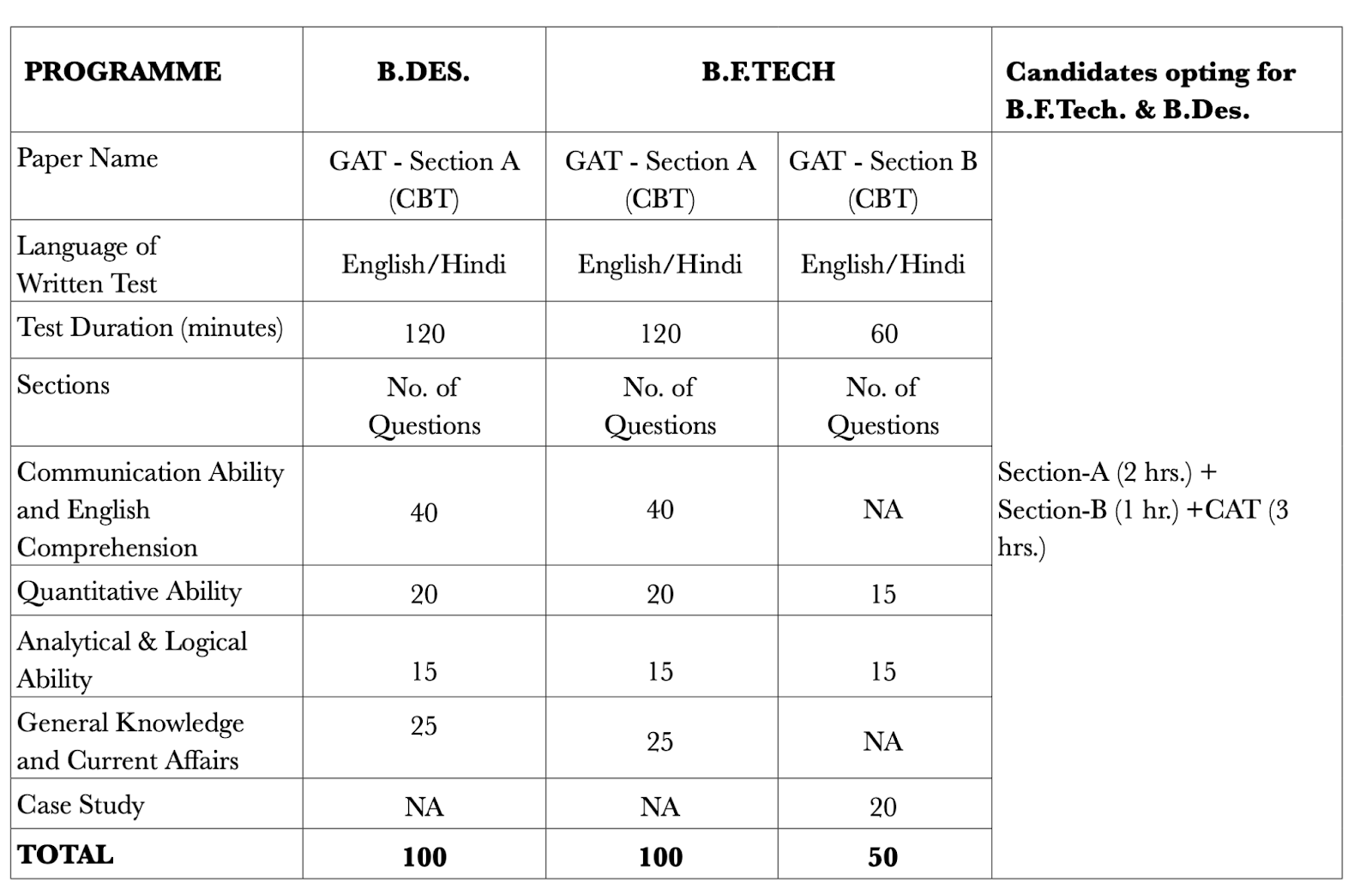
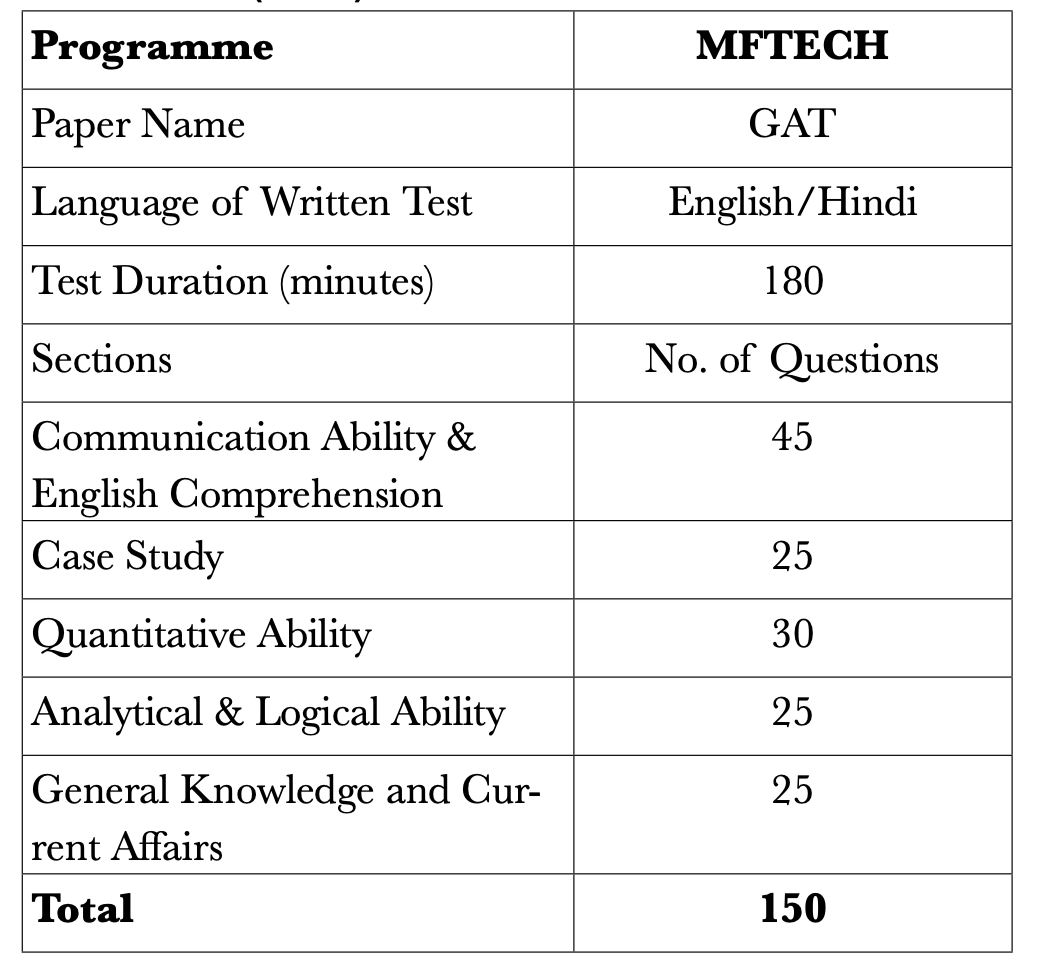
General Ability Test (GAT) - Computer Based Test (CBT) for M.F.Tech
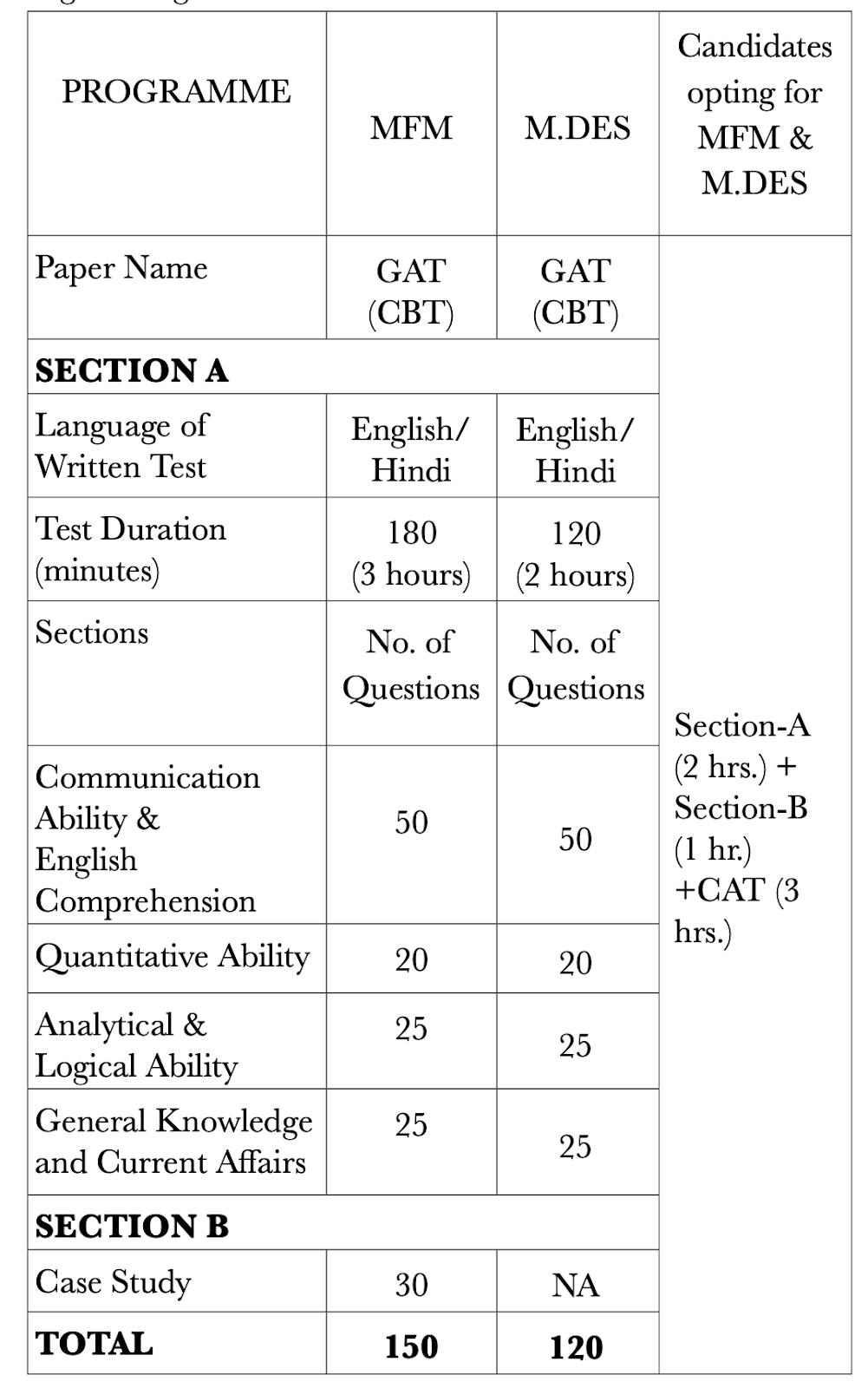
General Ability Test (GAT) - Computer Based Test (CBT) for M.Des and M.F.M
Creative Ability Test (CAT)
CAT evaluates:
- Creativity
- Observation
- Concept development
- Design ability
- Innovative use of colour and illustration
Candidates must not disclose identity through marks or personal details on answer sheets.
Note: M.FTech will also include some engineering-based questions.
Components of the General Ability Test (GAT)
1. Quantitative Ability
Covers:
Addition, multiplication, division, fractions, percentage, work & time,
distance, ratio & proportion, interest.
2. Communication Ability & English Comprehension
Includes:
Synonyms, antonyms, vocabulary, spellings, idioms, reading comprehension.
3. Analytical & Logical Ability
Tests:
Inference, problem identification, reasoning, pattern detection.
4. General Knowledge & Current Affairs
Current events, history, geography, economy, global developments.
5. Case Study
Evaluates:
Managerial skills, decision making, industry understanding.
NIFT Situation Test – For UG Design Programmes (B.Des)
- Material handling skills
- 3D model-making
- Creativity and innovation
- Space visualisation
- Concept development
- Colour sense
- Composition
- Construction skill
- Final presentation quality
Candidates must write a concept explanation in English. No outside material is allowed. Models are evaluated on the spot and are not preserved. Any identification marks or personal details on the model/writing lead to disqualification.
Related: How to make stunning portfolios for NIFT 2026
Group Discussion (GD) & Personal Interview (PI) – For All PG Programmes (M.Des, MFM, M.FTech)
Shortlisted PG candidates undergo GD & PI rounds.
Group Discussion (GD) Parameters
Candidates are assessed on:
- Conceptual clarity
- Knowledge of the given topic
- Contribution to the discussion
- Interpersonal skills
- Creativity & idea generation
- Problem solving approach
- Leadership qualities
- Communication effectiveness
Personal Interview (PI) Parameters
Candidates are evaluated on:
- Career orientation
- Aptness for the course
- Academic and extra-curricular achievements
- Communication skills
- General awareness
- Creativity and lateral thinking
NIFT 2026 Test Weightage for B.Des and M.Des
Undergraduate Programmes
| Programme | Test | Weightage |
|---|---|---|
| B.Des | CAT | 50% |
| GAT | 30% | |
| Situation Test | 20% | |
| Total | 100% | |
| B.F.Tech | GAT (Section A) | 30% |
| GAT (Section B) | 70% | |
| Total | 100% | |
| B.F.Tech Opting for B.Des | CAT | 50% |
| GAT (Section A) | 30% | |
| Situation Test | 20% | |
| Total | 100% |
Test Weightage for Postgraduate Programmes
| Programme | Test | Weightage |
|---|---|---|
| M.Des | GAT (Section A) | 30% |
| CAT | 40% | |
| Personal Interview | 30% | |
| Total | 100% | |
| MFM | GAT (Section A & B) | 70% |
| Personal Interview | 30% | |
| Total | 100% | |
| M.F.Tech | GAT | 70% |
| Personal Interview | 30% | |
| Total | 100% | |
| MFM Opting for M.Des | GAT (Section A) | 30% |
| CAT | 40% | |
| Personal Interview | 30% | |
| Total | 100% |
NIFT Exam Centres 2026
NIFT conducts the entrance exam across multiple cities in India to make it convenient for students from all regions. Candidates can choose their preferred exam centre while filling out the application form. The exact list is announced every year in the official application portal.
NIFT 2026 – Exam Centres List
| Sl. No. | State / UT | City |
|---|---|---|
| 1 | Andaman & Nicobar Islands | Port Blair |
| 2 | Andhra Pradesh | Kurnool |
| 3 | Andhra Pradesh | Rajahmundry |
| 4 | Andhra Pradesh | Tirupati |
| 5 | Andhra Pradesh | Vijayawada |
| 6 | Andhra Pradesh | Visakhapatnam |
| 7 | Arunachal Pradesh | Itanagar |
| 8 | Assam | Guwahati |
| 9 | Bihar | Bhagalpur |
| 10 | Bihar | Gaya |
| 11 | Bihar | Muzaffarpur |
| 12 | Bihar | Patna |
| 13 | Chandigarh | Chandigarh / Panchkula / Mohali |
| 14 | Chhattisgarh | Durg / Bhilai |
| 15 | Chhattisgarh | Bilaspur |
| 16 | Chhattisgarh | Raipur |
| 17 | Delhi | Delhi NCR |
| 18 | Goa | Panaji |
| 19 | Gujarat | Ahmedabad / Gandhinagar |
| 20 | Gujarat | Rajkot |
| 21 | Gujarat | Surat |
| 22 | Gujarat | Vadodara |
| 23 | Haryana | Hisar |
| 24 | Himachal Pradesh | Shimla |
| 25 | Himachal Pradesh | Hamirpur |
| 26 | Jammu & Kashmir | Jammu |
| 27 | Jammu & Kashmir | Srinagar |
| 28 | Jharkhand | Dhanbad |
| 29 | Jharkhand | Jamshedpur |
| 30 | Jharkhand | Ranchi |
| 31 | Karnataka | Bengaluru |
| 32 | Karnataka | Mangaluru |
| 33 | Karnataka | Mysuru |
| 34 | Kerala | Kochi |
| 35 | Kerala | Ernakulam / Alappuzha |
| 36 | Kerala | Kannur |
| 37 | Kerala | Kollam |
| 38 | Kerala | Kottayam |
| 39 | Kerala | Kozhikode |
| 40 | Kerala | Thiruvananthapuram |
| 41 | Kerala | Thrissur |
| 42 | Ladakh | Leh |
| 43 | Madhya Pradesh | Bhopal |
| 44 | Madhya Pradesh | Gwalior |
| 45 | Madhya Pradesh | Indore / Ujjain |
| 46 | Madhya Pradesh | Jabalpur |
| 47 | Madhya Pradesh | Sagar |
| 48 | Madhya Pradesh | Satna |
| 49 | Maharashtra | Amravati |
| 50 | Maharashtra | Chhatrapati Sambhaji Nagar |
| 51 | Maharashtra | Kolhapur |
| 52 | Maharashtra | Mumbai / Navi Mumbai / Thane |
| 53 | Maharashtra | Nagpur |
| 54 | Maharashtra | Nashik |
| 55 | Maharashtra | Pune |
| 56 | Manipur | Imphal |
| 57 | Meghalaya | Shillong |
| 58 | Mizoram | Aizawl |
| 59 | Nagaland | Kohima |
| 60 | Odisha | Balasore |
| 61 | Odisha | Berhampur – Ganjam |
| 62 | Odisha | Bhubaneswar |
| 63 | Odisha | Sambalpur |
| 64 | Punjab | Amritsar |
| 65 | Punjab | Jalandhar |
| 66 | Punjab | Ludhiana |
| 67 | Rajasthan | Jaipur |
| 68 | Rajasthan | Jodhpur |
| 69 | Rajasthan | Kota |
| 70 | Rajasthan | Udaipur |
| 71 | Rajasthan | Sikar |
| 72 | Sikkim | Gangtok |
| 73 | Tamil Nadu | Chennai |
| 74 | Tamil Nadu | Coimbatore |
| 75 | Tamil Nadu | Cuddalore |
| 76 | Tamil Nadu | Madurai |
| 77 | Tamil Nadu | Nagercoil |
| 78 | Tamil Nadu | Puducherry |
| 79 | Tamil Nadu | Salem |
| 80 | Tamil Nadu | Thanjavur |
| 81 | Tamil Nadu | Tiruchirappalli |
| 82 | Tamil Nadu | Vellore |
| 83 | Telangana | Hyderabad |
| 84 | Telangana | Warangal |
| 85 | Tripura | Agartala |
| 86 | Uttar Pradesh | Agra |
| 87 | Uttar Pradesh | Gorakhpur |
| 88 | Uttar Pradesh | Kanpur |
| 89 | Uttar Pradesh | Lucknow |
| 90 | Uttar Pradesh | Meerut |
| 91 | Uttar Pradesh | Prayagraj (Allahabad) |
| 92 | Uttar Pradesh | Varanasi |
| 93 | Uttar Pradesh | Bareilly |
| 94 | Uttarakhand | Dehradun |
| 95 | Uttarakhand | Haldwani |
| 96 | Uttarakhand | Roorkee |
| 97 | West Bengal | Asansol |
| 98 | West Bengal | Durgapur |
| 99 | West Bengal | Kolkata |
| 100 | West Bengal | Siliguri |
Important Notes
- Candidates must select their preferred exam city while filling the application form.
- Once the application form is submitted, centre changes may not be allowed except during the edit window.
- The final exam centre allocated will be mentioned on the admit card.
- Students must reach the centre on time with their admit card and valid ID.
Also Read: India Is Getting Its Own Clothing Size Chart — Thanks to NIFT!
Documents Required for NIFT 2026
Mandatory:
- Passport-size photograph
- Scanned signature
- Class 10 & 12 certificates
- Valid ID proof
If Applicable:
- SC/ST/OBC-NCL certificate
- EWS certificate
- PwD certificate
- NRI documents
For PG Applicants:
- Bachelor’s degree certificate
- Final year mark sheets
NIFT 2026 Application Fee
(Approximate and subject to official update)
- General/OBC (NCL): ₹3,000
- SC/ST/PwD: ₹1,500
- Late fees apply after the last date.
How to Apply for NIFT 2026 – Step-by-Step Process
The NIFT 2026 application process is conducted entirely online. Students must follow each step carefully to ensure successful submission of their form.
Step 1: Visit the Official NIFT Admission Portal
Go to the official NIFT admissions website where the online application form is released for all UG and PG programmes.
Step 2: Register as a New Candidate
Click on New Registration and enter:
- Name
- Email ID
- Mobile Number
- Date of Birth
- Category
After submitting, you will receive login credentials for your account.
Step 3: Fill in the Online Application Form
Log in using your credentials and complete the form by entering:
- Personal details
- Academic qualifications
- Programme applied for (B.Des, B.FTech, M.Des, MFM, M.FTech)
- Exam centre preference
- Address and contact information
Ensure all details match your certificates.
Step 4: Upload Required Documents
Upload scanned copies in the correct size and format:
- Passport-size photograph
- Signature
- Category certificate (if applicable)
- PwD certificate (if applicable)
- Academic documents
All files must be clear, recent and legible.
Step 5: Pay the Application Fee
Complete the payment using:
- Debit/Credit Card
- Net Banking
- UPI
Save the payment receipt for reference.
Step 6: Review and Submit the Application
Carefully review all details before final submission. Once submitted, no major changes can be made except during the official edit window.
Step 7: Download the Confirmation Page
Save a copy of:
- Filled application form
- Payment receipt
- Confirmation page
These documents may be required later for verification.
Step 8: Check for Updates
Regularly visit the official website for:
- Admit card 2026 release
- Written exam notifications
- Situation Test / GD-PI dates
- Result announcements
NIFT 2026 Admit Card
The NIFT 2026 Admit Card is an essential document that every candidate must carry on the day of the examination. It will be released online on the official NIFT admission portal in February 2026. Candidates must download and print the admit card as soon as it becomes available.
How to Download the NIFT 2026 Admit Card
- Visit the official NIFT admissions website
- Click on the “Download Admit Card” link
- Log in using your registered email ID and password
- View and download the admit card
- Take 1–2 clear printouts for exam day use
Details Mentioned on the Admit Card
- Candidate’s name and photograph
- Roll number
- Application number
- Exam date and time
- Exam centre address
- Category and programme applied for
- Important instructions for the exam
Documents to Carry on Exam Day
- Printed copy of the NIFT Admit Card
- Valid photo ID (Aadhaar Card, Passport, Driving License, PAN Card, or School ID)
- Necessary stationery as permitted in the instructions
Important Instructions
- The admit card will not be sent by post. It must be downloaded online.
- Ensure that all details printed on the admit card are correct.
- Any errors must be immediately reported to NIFT authorities.
- Candidates must arrive at the test centre well before reporting time.
- Without the admit card and valid ID, entry into the exam hall will not be permitted.
NIFT 2026 Results
The NIFT 2026 result will be released in two stages—first for the written exam (GAT & CAT) and then the final result after the Situation Test or GD/PI. All results are published online on the official NIFT admission portal.
Stage 1: Written Exam Result (GAT & CAT)
- Expected release: March/April 2026
- Candidates can check their scores by logging in with their registered email ID and password.
- The scorecard will display section-wise marks, total marks and qualification status.
- Only candidates who qualify in the written test will be shortlisted for
the next stage:
- NIFT Situation Test (for B.Des)
- GD/PI (for PG Programmes)
Stage 2: Final Result
- Expected release: June 2026
- The final merit list is prepared by combining:
- Written Exam Score
- Situation Test Score (B.Des)
- GD/PI Score (PG)
- The final result displays:
- Overall Rank
- Category Rank
- Qualification Status
- Eligibility for counselling
How to Check the NIFT 2026 Result
- Visit the official NIFT admission portal
- Click on the “NIFT 2026 Result” link
- Log in with your email ID, date of birth and application number
- Download the scorecard and keep a copy for counselling
Post-Result: Counselling
- Campus allotment
- Programme selection
- Document verification
- Fee payment
Choice filling and seat allocation will depend on:
- Rank
- Category
- Seat availability
- Campus preferences
Important Points
- Results will not be sent via email or post.
- Scorecards must be downloaded only from the official website.
- All shortlisted candidates must attend counselling as per the schedule.
- Failure to appear for counselling may lead to cancellation of the seat.
Tips to Crack NIFT 2026
Preparing for NIFT requires a balance of creativity, logical thinking, speed, and consistent practice. These tips will help students perform well in CAT, GAT and the Situation Test or GD/PI rounds.
Tips for CAT (Creative Ability Test)
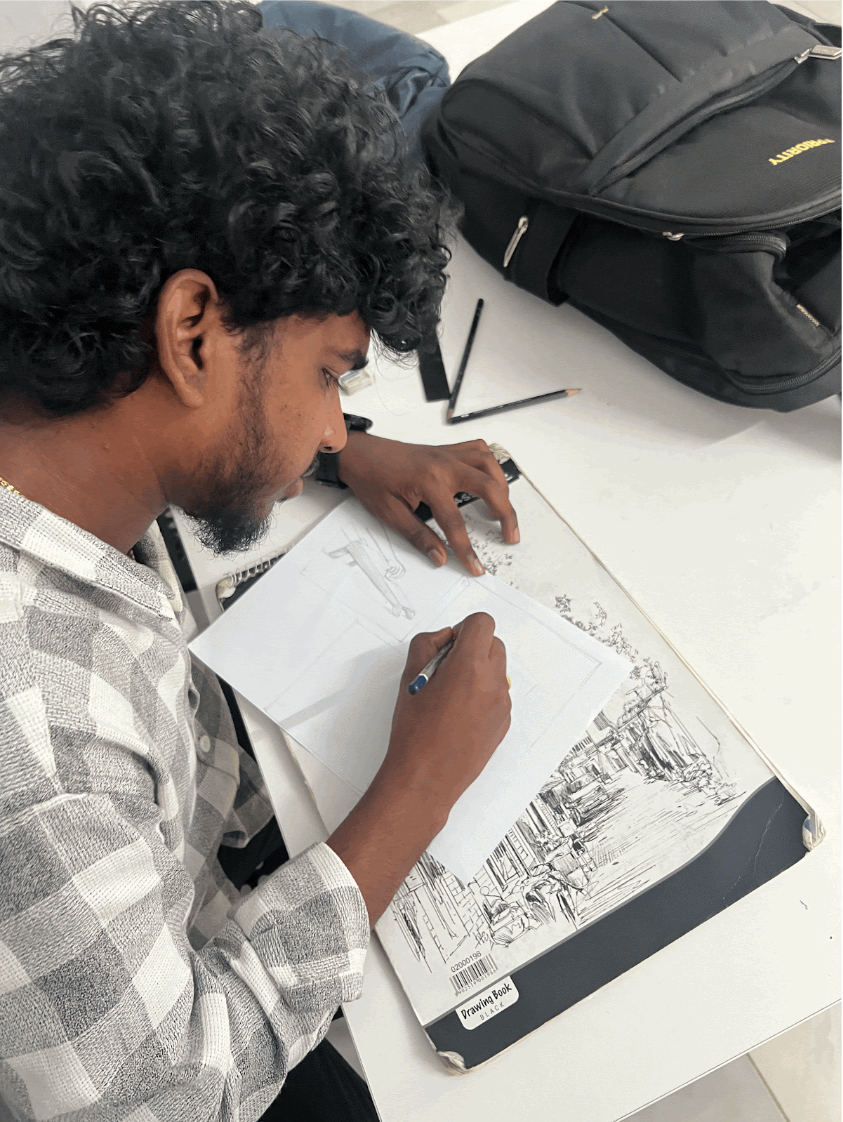
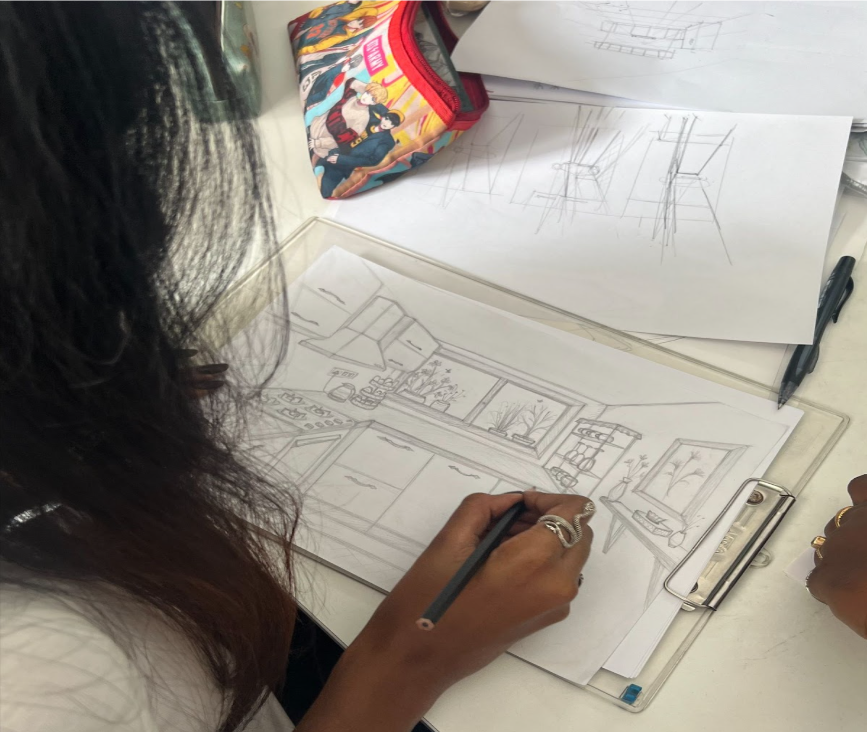
- Practice sketching every day to build speed and confidence.
- Focus on perspective, proportion, shading and clean lines.
- Improve visual storytelling with clear concepts and message-driven illustrations.
- Enhance observational skills by sketching real-life objects and situations.
- Use colours creatively but thoughtfully—avoid overuse or messy shading.
- Solve previous years’ CAT questions to understand patterns.
- Maintain a sketchbook to track improvement and develop a personal style.
Tips for GAT (General Ability Test)
- Strengthen basics in quantitative ability—percentages, ratios, distance, time & work, simple calculations.
- Improve English comprehension and vocabulary by reading daily.
- Practice logical reasoning and pattern-based questions.
- Keep up with current affairs through news apps, magazines and GK platforms.
- Attempt full-length mock tests to improve accuracy and time management.
Tips for the Situation Test (For B.Des)
- Practice building 3D models with simple materials such as paper, straws, tape, clay, foil and mountboard.
- Focus on neatness—presentation is as important as the idea.
- Start with a concept, then build the model around it with clarity.
- Manage time wisely by planning the design before constructing.
- Use all materials efficiently; judges observe financial and material discipline.
- Write a clear, concise explanation of your model in English.
Tips for GD/PI (For PG Programmes)
- Improve communication skills and practice speaking confidently.
- Read about fashion business, retail, sustainability, global brands and case studies.
- Participate in mock GD sessions to enhance group interaction and idea contribution.
- Prepare a strong portfolio (if asked) showcasing creativity, projects and design thinking.
- Stay updated on industry trends and fashion technology innovations.
- Be authentic and clear about your goals during interviews.
General Tips for All NIFT Aspirants
- Solve previous year question papers regularly.
- Take timed mock exams for both CAT and GAT.
- Identify weak areas early and work on them consistently.
- Create a study plan that balances creativity and aptitude preparation.
- Avoid stress by taking short breaks and staying organised.
- Practice smart, not just hard—quality matters more than quantity.
- Stay confident and trust your preparation.
Download NIFT SAMPLE PAPERS
NIFT Sample Papers
Practicing with NIFT sample papers is one of the most effective ways to prepare for the exam. The sample papers help students understand the exam pattern, question style, difficulty level and time management required for CAT, GAT and Situation Test rounds.
Why NIFT Sample Papers Are Important
- Help students understand the actual exam structure
- Improve speed and accuracy for GAT
- Build confidence for CAT sketching and creative tasks
- Highlight strengths and weak areas
- Familiarise students with previous trends and commonly asked question types
- Useful for self-evaluation and timed practice sessions
B.Design NIFT Sample Papers
B.Design CAT Sample Paper
B.Design Sample Paper
B.Fashion Technology Sample Paper
M.Design NIFT Sample Papers
M.Design CAT Sample Paper
M.Design Sample Paper
M.Fashion Management Sample Paper
M.Fashion Technology Sample Paper
How to Use NIFT Sample Papers Effectively
- Solve GAT papers under timed conditions to build speed in quantitative, reasoning, English and GK sections.
- Practice CAT papers to sharpen sketching, conceptual thinking, visualization and creative composition.
- After solving, analyse answers (especially mistakes).
- Attempt papers periodically to build exam stamina and confidence.
Why MAD School is a Top Choice for NIFT Preparation
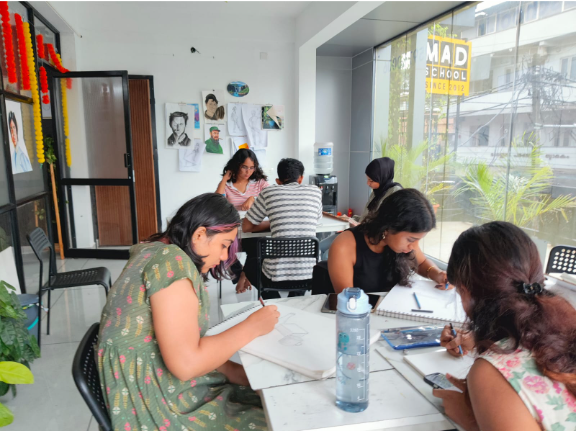
If you are serious about cracking NIFT 2026 and building a future in design, MAD School gives you the perfect start by offering structured NIFT 2026 Coaching. With expert faculty, personalised guidance, CAT & GAT training, daily sketching practice, situation test workshops, mock exams and one-on-one mentoring, we help students understand concepts deeply and excel in every stage of the exam. Whether you choose online or offline classes, our structured learning, doubt-clearing sessions and creative environment ensure you stay motivated and confident throughout your preparation. Join MAD School and take the first step towards securing your dream seat at NIFT in 2026.
Apply for NIFT 2026
Students can apply through the official NIFT admission portal.
| Different Between NATA V/S JEE PAPER 2 2026 | UCEED 2026: Complete Guide |
| Other Top Design Colleges in India | List of All NIFT Campus Locations and Comparisons |